📄 Ver transcrição completa (18391 palavras)
[00:00] You know,
[00:01] I had these chronic headaches.
[00:04] Keep going to all these different
[00:05] chiropractors.
[00:07] Nothing seems to change.
[00:10] Tell me,
[00:13] why should I go with you?
[00:16] Uh
[00:18] I don't know yet. I don't know if you
[00:20] should
[00:21] Why should I go with you?
[00:23] We'll find out
[00:24] if we can accept you. Why should I go
[00:27] with you?
[00:29] Well,
[00:29] we are Synergy Integrated Health. Mhm.
[00:32] You should go with our company Mhm.
[00:34] because Dr. Lim is a doctor of advanced
[00:38] chiropractic
[00:39] Mhm. specializing in neuropathy. Mhm.
[00:46] I have over 30 years of experience and I
[00:48] get results.
[00:50] Why
[00:52] should I go with you?
[00:54] You'll tell me after we finish our
[00:55] conversation. Okay, I want all you, you,
[00:58] and you to come up here with me on stage
[01:00] real quick. Come on up, let's go.
[01:03] Are you a chiropractor or case manager?
[01:05] I'm a chiropractor. One of the smart
[01:06] guys. Okay.
[01:09] If I asked any of your competitors in
[01:11] your city the same question and I said,
[01:15] "Why should I go with them?"
[01:18] What do you think they might say?
[01:20] Something very similar but without the
[01:22] confidence.
[01:22] Mhm.
[01:24] If I asked your competitors, any of them
[01:26] in your city, the same exact question
[01:29] what do you think they would say?
[01:31] They'd tell you what they do. Mhm. And
[01:33] if I asked your competitors
[01:36] the same exact question what do you
[01:38] think they would say?
[01:40] They would say that their business is
[01:43] the best because they get results and
[01:46] they specialize in whatever it is you
[01:48] are
[01:50] experiencing.
[01:51] Okay.
[01:52] So, what I think
[01:54] I just heard all of you say
[01:57] is that in your prospect's mind
[02:00] you all sound the what? You all sound
[02:02] the same.
[02:03] Could that be
[02:05] a problem for you?
[02:07] Okay. All right, you guys can sit down.
[02:09] Lovely job. Well done.
[02:11] Now, be ready because
[02:14] I've been known to bring you back up and
[02:16] a lot of other people. You might want to
[02:18] be on your toes today. Now, if I asked
[02:20] you
[02:22] to describe
[02:23] the word sales or selling
[02:27] in just one simple word. Now, if you're
[02:30] one of our clients cuz I've seen several
[02:32] clients in here
[02:33] zip it right now.
[02:36] But, if I asked you to describe the word
[02:38] sales or selling
[02:41] in just one word
[02:43] what would that word be?
[02:46] Tell me, what would that word be? If I
[02:47] asked you to describe the word sales or
[02:49] selling in one word, what would that
[02:51] word be?
[02:51] Service. Service, what else?
[02:54] Growth.
[02:55] Needs, what else?
[02:58] Persuasion, what else?
[03:00] Pushy, what else?
[03:02] Influence, what else?
[03:04] Scary? Could be trouble.
[03:07] Okay, what if we took everything all of
[03:08] you just said and we wrapped it into one
[03:10] word and that word was this.
[03:14] Change.
[03:19] All sales are, all selling is is simply
[03:23] change.
[03:25] It's about how good you are
[03:27] at getting your prospects to view that
[03:29] in their mind that by them changing
[03:32] their situation, that means purchasing,
[03:35] you know, treatment plans from you that
[03:37] by them doing that, that is far less
[03:39] risky for them than them doing nothing
[03:42] at all, staying in the status quo, their
[03:44] problems stay the same, and nothing ever
[03:47] changes.
[03:49] Which is more risky?
[03:51] Now,
[03:53] here's your biggest problem.
[03:55] Human beings don't like change.
[03:59] See what I just said? All selling is is
[04:00] change, yet human beings don't like
[04:02] change even though we say we do. And why
[04:05] do we not like change? We especially do
[04:07] not like change
[04:08] when it's initiated by some pushy
[04:10] salesperson, case manager
[04:13] chiropractor
[04:14] that tries to push their solutions too
[04:17] early in the conversation. And
[04:18] repeatedly human behavior shows that we
[04:21] value something
[04:24] that is more
[04:25] familiar to us even if we don't like it
[04:28] that much over something that is new,
[04:30] something that is foreign to us. Would I
[04:32] be right?
[04:33] I'll give you an example. Raise your
[04:35] hand if you know anybody, a friend, a
[04:37] relative, a neighbor, a business
[04:38] associate, somebody you work with that
[04:40] complains every single day about the
[04:42] relationship they're in. Raise your
[04:43] hand. Everybody has the person, right?
[04:46] Oh, they're this, they're that, they're
[04:47] this.
[04:48] And you always wonder what?
[04:51] Why they
[04:52] stay in the relationship. Well, why is
[04:56] that? Because they're human and they're
[04:57] afraid of change. Well, there's that
[05:00] word change again. See, that's what
[05:02] you're going up against to some degree
[05:04] with pretty much every potential
[05:06] customer you're ever going to talk to.
[05:11] it's okay.
[05:13] How do we help
[05:15] your prospects overcome
[05:18] the fear of change?
[05:20] It's quite easy once you acquire the
[05:22] skill sets to do that. It's really,
[05:25] really hard if you don't. Now, how do we
[05:27] do that? How are we going to do that
[05:28] together? Here's where we're going to
[05:29] start.
[05:31] One thing that we all have to realize is
[05:33] this very simple notion. Is that you're
[05:35] not selling the thing.
[05:39] What are you selling?
[05:40] You're selling the results
[05:43] of what that thing does. Now, for every
[05:46] potential customer you talk to, that
[05:47] could be different, right? For somebody,
[05:49] it could be
[05:51] you're selling them on what?
[05:53] What the treatment plan does because
[05:55] it's going to save their foot from being
[05:57] amputated. That's what you're selling.
[06:00] You might be selling somebody else by
[06:03] allowing them to be able to walk so they
[06:05] can enjoy their grandkids growing up or
[06:07] golfing with their friends. You might be
[06:08] selling a treatment plan, the results of
[06:11] that, that gets rid of their chronic
[06:13] headaches so they can go back to work
[06:14] and provide for their family.
[06:16] See, that's what you're selling, the
[06:18] results of what the treatment plans do,
[06:22] not the treatment plans itself. Are you
[06:23] with me on that? All right, now,
[06:26] how do we do this together?
[06:29] Here's a question that we have to ask
[06:31] ourselves. How are each of you
[06:34] going to stand out in your prospect's
[06:36] mind?
[06:38] Because from what I heard up here
[06:41] from what you were saying, we all sound
[06:42] the
[06:43] same to the prospect.
[06:46] And because we sound the same, what do
[06:48] they do?
[06:49] Commoditize you.
[06:51] Right?
[06:52] See, it's too expensive. I need
[06:54] something cheaper.
[06:56] See where we're at? Okay, now, why does
[06:58] that happen? How are you going to have a
[07:00] competitive advantage over everybody
[07:01] else in 2024, 2025, and for decades to
[07:05] come?
[07:06] How do you stand out?
[07:09] Every chiropractor's services say what?
[07:12] Is anybody saying we're the 15th best in
[07:14] the city?
[07:15] No, we all say we're good, we can do it,
[07:17] we we all say we can get it done. So, in
[07:19] your prospect's mind, we all sound very
[07:20] similar. So, how do we stand out in
[07:23] their mind? All of you are learning
[07:26] from this event and from the the the,
[07:29] you know, coaching programs of Dr. Gum
[07:30] and their team, systems, operations,
[07:32] marketing. You're all learning that. So,
[07:33] what causes you to stand out in their
[07:37] Simply this.
[07:40] It's right here.
[07:41] Write that down. The ones who will own
[07:44] this upcoming market are simply the ones
[07:48] who learn how to best communicate with
[07:50] their prospects. That simple. The ones
[07:54] who know what to say and ask that will
[07:56] cause their prospects to want to engage,
[07:57] to want to open up
[08:00] instead of trying to get rid of you.
[08:03] So, what gives you the competitive
[08:04] advantage?
[08:05] Today, I'm going to show you three
[08:06] things.
[08:07] Number one.
[08:10] Here's what we're going to talk about.
[08:11] How do you become the trusted authority
[08:13] in your prospect's mind? How do they
[08:15] view you as the market leader, the
[08:18] expert who they will never go away from
[08:21] no matter what?
[08:23] Here we go. Number one.
[08:25] We talked about earlier. We have to
[08:27] learn how to become a problem finder,
[08:29] problem solver, not a product pusher.
[08:31] Product pushers don't do that well.
[08:33] That's why they get commoditized on
[08:35] pricing. Number two, asking the right
[08:37] questions but at the right time
[08:40] and especially with the right tone.
[08:43] Tonality, Jeremy, what are you talking
[08:45] about?
[08:46] That might be important to you. Anybody
[08:47] ever read a book that says 93% of
[08:49] communication is by your
[08:52] nonverbal,
[08:53] your body language, and your tonality?
[08:56] Anybody ever learned how to use your
[08:59] body language and tonality? Advanced
[09:02] learning.
[09:04] Nobody.
[09:05] How many years have all of you gone to
[09:07] sales and persuasion school?
[09:09] How many years did you go to
[09:10] chiropractic school?
[09:12] Oh, okay. Could be a problem there. Now,
[09:15] there's some questions that we have to
[09:16] learn
[09:17] that require more of a a curious tone.
[09:20] There's other questions we have to learn
[09:22] that require more of a confused tone.
[09:26] What does that mean, Jeremy? There's
[09:28] other questions you're going to have to
[09:29] learn that require more of a challenging
[09:31] tone.
[09:32] There's others that are going to require
[09:35] more of a
[09:36] concerned tone.
[09:38] A tone that shows more empathy.
[09:42] Are you 100% sure
[09:45] the questions you're using now are the
[09:47] right ones?
[09:51] Are you 100% sure that you know how to
[09:54] use your tonality
[09:56] to get your prospects to emotionally
[09:58] open up.
[10:01] And number three,
[10:04] eliminating sales resistance
[10:07] so your prospects let their guard down.
[10:11] All right.
[10:13] I'm going to tell you
[10:14] I'm going to give you a little bit of my
[10:15] background.
[10:17] Because my background relates
[10:21] to what is necessary
[10:23] if you want to take your business if you
[10:25] own the practice or practices
[10:27] or if you're case manager, sales people
[10:31] you want to take your sales to a level
[10:32] that most people don't believe they can
[10:34] get to.
[10:36] Now, I got started in sales 23 years ago
[10:39] as a broke, burned out college student.
[10:41] And I got my first job selling home
[10:42] security systems door-to-door. Raise
[10:44] your hand if you ever sold door-to-door.
[10:47] Raise your hand.
[10:48] I got to see who my people were. That's
[10:50] where I started. Now, you know what we
[10:51] went through, right?
[10:53] They give you the script. They give you
[10:54] a couple books by the sales gurus. They
[10:57] drive you out in a van.
[10:59] Am I right?
[11:00] You guys starting to remember this? They
[11:02] drive you out in a van
[11:04] and they basically do this. They
[11:07] kick you out of the van
[11:09] and they say, "Go make some sales. It'll
[11:11] be easy. We'll pick you up after dark."
[11:13] Everybody with door-to-door people, you
[11:15] know it. And I still remember being the
[11:17] last one block dropped off in the block.
[11:19] I looked back at my sales manager in the
[11:22] van. His name was Xane Anderson. He had
[11:25] the cur- You know the surfer guys, the
[11:27] blonde hair, you know how they talk?
[11:29] He's like, "Yo, Minor. Remember, when
[11:32] you knock on the door, show them how
[11:34] excited you are.
[11:36] Show them your enthusiasm. Show them
[11:38] that you believe in the product and
[11:40] they're going to believe in the
[11:41] product." I was like, "That makes sense.
[11:43] If I believe in it if I'm really excited
[11:46] they're somehow
[11:48] going to be excited as well." What did I
[11:51] know? So, I started knocking on the
[11:52] doors and I started talking about my
[11:54] features and benefits and I was really
[11:56] excited. And I said we were the number
[11:58] one in the market there and we could do
[11:59] the best installs and we had the best
[12:01] customer service and the highest quality
[12:03] of products and service and we had the
[12:05] best owners and we had a triple A rating
[12:07] with the Better Business Bureau.
[12:10] And suddenly, to my dismay
[12:12] from the very first store
[12:15] I started getting all these objections.
[12:18] What?
[12:19] They didn't tell me about that.
[12:21] We don't need it.
[12:22] We can't afford it. It's too expensive.
[12:25] We already talked with somebody from
[12:27] your company. I need to talk with the my
[12:28] spouse. I need to do more research. I
[12:30] need to keep looking around. I need to
[12:32] think it over. Can you call me back in a
[12:34] week, a month, a year later?
[12:36] Raise your hand if you've ever got any
[12:37] of those objections.
[12:39] Only half the room. Some of you never
[12:41] get any objections. You guys are good.
[12:44] Now, after probably set That's actually
[12:46] not a picture of me. That's crazy. After
[12:48] about 7 to 8 weeks of nonstop rejection,
[12:51] barely making any sales. Now, when
[12:52] you're door-to-door, do they pay you a
[12:54] really high base salary?
[12:56] Oh, no. Straight commission. So,
[12:57] everybody gets hired. So, if you don't
[12:59] make sales, you don't
[13:01] make any moolah. Not good for you. So,
[13:04] after about 7 to 8 weeks of all that I
[13:06] remember standing on a curve
[13:09] one late Friday evening. You know the
[13:11] summers.
[13:12] Anybody been in those door-to-door
[13:13] summer programs? Just a few. You know,
[13:15] if you have, you know what I'm talking
[13:16] about. Just sweat dripping down your
[13:19] chest, your back, your legs just jello
[13:22] after like 13 hours of walking around
[13:24] the doors, doors slammed in your face,
[13:26] made zero sales that day.
[13:28] So, zero dollars an hour. And in fact,
[13:32] for the entire week, I'd worked like 65
[13:34] hours and made zero sales. So, that
[13:36] means zero dollars an hour. And I
[13:38] remember feeling to myself, you know
[13:40] maybe selling
[13:43] maybe selling just wasn't for me.
[13:49] Maybe I just wasn't a born salesperson
[13:52] like everybody else.
[13:56] Have you ever felt that way yourself?
[14:00] Have you ever looked at your bank
[14:02] account
[14:04] and you had more going out than you had
[14:05] coming in?
[14:07] That's where I was at.
[14:09] Now, when Xane, the surfer manager,
[14:11] picked me up that day, he popped in a
[14:13] Tony Robbins CD
[14:15] where he was talking about skill level
[14:17] that completely changed my viewpoint of
[14:19] what skills actually meant. Yes, 22
[14:21] years ago, they used to still listen to
[14:23] these round things
[14:25] called CDs. I know it's kind of weird,
[14:26] isn't it, right? Now, Tony said
[14:27] something like this.
[14:29] Tony, forgive me if you're listening. I
[14:31] might have be butchering this. This is a
[14:32] long time ago.
[14:34] He said this.
[14:36] He said
[14:38] you will fail
[14:44] if you don't learn the right skills
[14:47] necessary to succeed. You will fail
[14:51] if you don't learn the right skills. Now
[14:55] here's the kicker.
[14:57] He went on to say, "Everybody's taught
[14:58] skills.
[15:00] We're all taught skills when we get in
[15:02] any job, right?"
[15:04] But he said the people who don't do as
[15:06] well
[15:07] are the ones who are not taught the
[15:08] right ones. That there's skill level
[15:12] that can be taught by people who are far
[15:14] more successful
[15:16] that gets you a high level of success
[15:18] compared to low skill level.
[15:21] Now, for me as a 21-year-old kid, 22 at
[15:24] that time that was like a lightbulb
[15:26] moment. That was like
[15:28] I would say divine
[15:30] intervention from the heavens that
[15:32] maybe, just maybe
[15:35] what the company was training me
[15:37] what I was learning from the sales gurus
[15:41] maybe they just weren't the right skills
[15:42] anymore. Maybe they're just out date,
[15:44] didn't work as well.
[15:45] So, I was like, "Okay, I've got to do
[15:46] something. Zero dollars an hour
[15:49] probably not going to
[15:51] help that much.
[15:53] I have to learn how to do this
[15:56] because
[15:58] I know you
[16:02] like me
[16:04] want to provide a great life to your
[16:06] family. Is that why you're here today?
[16:08] You all came here because you want to do
[16:10] what? You want to improve your skill
[16:13] level.
[16:14] Now, here is my major dilemma though
[16:17] I was using these traditional selling
[16:19] skills
[16:20] from the company
[16:22] and from the gurus. I would notice some
[16:23] of them would work.
[16:27] Let's get some pictures up there. I
[16:28] noticed some of those would work
[16:35] when I used them.
[16:37] Yes, there was. But I noticed a lot of
[16:39] them didn't work very well at all.
[16:42] And I would use them. I would actually
[16:43] see my prospects like the body language
[16:47] like kind of tense up. Have you ever
[16:49] seen that? When you've used some of
[16:50] those techniques, you can tell that
[16:52] they're like
[16:53] oh my gosh. And you I would ask
[16:55] questions and they would give me vague,
[16:57] generalized, surface level answers.
[16:59] Raise your hand if you ask questions and
[17:00] you get vague, generalized, surface
[17:03] level answers and their feet are about
[17:05] to fall off. Could Why is that? And I'm
[17:07] like, "What What is causing that? What
[17:09] am I doing wrong?" I would notice they
[17:11] would just stay surface level and just
[17:12] shut down all the time. Now, at the same
[17:14] time
[17:16] I was in college
[17:18] my major is behavioral science and human
[17:20] psychology, the study of the brain and
[17:22] how human beings make decisions.
[17:25] Would that be important if we're
[17:28] wanting to learn
[17:29] to persuade and influence our prospects
[17:32] if we know how their brain makes
[17:34] decisions?
[17:35] Why do they say no instead of yes?
[17:38] What's going on up there that triggers
[17:40] that reaction? Now, my professors
[17:43] they were telling me that the most
[17:44] persuasive way to communicate was here.
[17:47] The gurus in all their programs
[17:48] basically
[17:50] here. So, we're talking exact opposite.
[17:52] So, I'm like, "What do I do here?
[17:55] How do I learn
[17:57] how do I learn how to ask the right
[17:58] questions
[18:01] that would get my prospects to
[18:04] pull me in?"
[18:05] Cuz I didn't like the pushy pressure.
[18:07] Who in here likes to push and pressure?
[18:10] No bueno. Because when you do it, you
[18:11] feel what?
[18:13] You feel what when you do it?
[18:15] What do you feel?
[18:17] You feel kind of weird. What do you
[18:18] think the prospect's feeling if you feel
[18:20] that? It could be trouble, right? So,
[18:22] how do I learn how to use my body
[18:23] language
[18:25] how do I use my tone
[18:27] to get my prospects to let their guard
[18:29] down and actually want to open up to me
[18:31] and tell me what their real problems
[18:33] are?
[18:34] So, I started learning these techniques
[18:36] that would work with human behavior.
[18:40] And I started to get my prospects
[18:42] to do all the work.
[18:45] I started to get my prospects to sell
[18:47] themselves. I started to get my
[18:49] prospects to overcome their own concerns
[18:52] and I started to get them to learn how
[18:54] to get them to pull me in
[18:56] and all of a sudden selling became
[18:58] very enjoyable, very easy and
[19:00] exceptionally profitable. Now, why do I
[19:04] tell Why did I just tell you my story?
[19:07] Cuz none of you care about my story.
[19:10] Whose story do you care about? Your
[19:11] story, right? You're a human being. This
[19:13] is be- human behavior 101. I told you
[19:15] that because I want you to imagine me
[19:17] within
[19:19] 4 years of that
[19:21] of like zero dollars per day, within 4
[19:24] years of that I was making multiple
[19:26] seven figures in commissions every year
[19:29] as a W-2 salesperson.
[19:32] 4 years before I almost quit because I
[19:35] believed the lie that you're either a
[19:37] born salesperson or not.
[19:40] You see, I'm
[19:42] I'm not
[19:46] I'm not anyone
[19:48] famous.
[19:50] In fact,
[19:55] I'm just like you.
[19:59] I'm a person who very early in their
[20:00] life realized if I wanted to have a
[20:02] great lifestyle for my future family, I
[20:04] was not going to have to I couldn't
[20:06] follow the status quo like everybody
[20:07] else. That if I was going to be in
[20:09] sales, I couldn't use the techniques
[20:11] everybody else was using because I would
[20:13] what?
[20:14] Get the same results. You see,
[20:16] unfortunately for me, I wasn't born out
[20:18] of my mother's womb with advanced
[20:20] questioning skills.
[20:22] Raise your hand if you're born with
[20:22] advanced questioning skills.
[20:25] Oh, nobody.
[20:26] I wasn't born out of my mother's womb
[20:28] with advanced tonality skills. Raise
[20:30] your hand if you were born with advanced
[20:31] tonality skills.
[20:33] Oh, nobody. See, I wasn't born with
[20:36] advanced objection handling and
[20:39] prevention skills.
[20:42] I had to acquire those skills.
[20:44] I had to learn those skills.
[20:47] So, if a kid who grew up in the middle
[20:50] of Missouri
[20:52] on a cattle ranch outside of a town with
[20:55] less than 800 people can acquire those
[20:57] skills,
[20:59] what does it mean to you?
[21:01] It means
[21:03] you can do it, too. Even if you're doing
[21:05] really well in your practice or as a
[21:07] case manager, once you acquire more
[21:09] skills, more advanced skills, you can do
[21:11] what? Two, three, five, 10. You can go
[21:14] You can write your own ticket anywhere
[21:15] in the world. Now, how are we going to
[21:16] do this?
[21:18] Cuz it's all talk until we what?
[21:21] It's all dreaming until we what?
[21:24] We learn the skills. See, you all
[21:26] dreamed about being a chiropractor until
[21:28] you what?
[21:29] Learned how to be a chiropractor. I
[21:31] can't believe it. This is crazy. Now,
[21:33] become a problem finder, problem solver,
[21:35] not a product pusher. Raise your hand
[21:39] if the prospects you talk to
[21:41] have problems
[21:44] and or emotional needs. Raise your hand.
[21:47] If I don't see every hand raised, I'm
[21:48] coming after you right now. I can see
[21:50] you back there.
[21:51] Everything ever invented solves a
[21:54] problem and or emotional need, right?
[21:56] Does a Ferrari $500,000 Ferrari solve a
[21:59] problem?
[22:00] Not really, unless you're race car
[22:02] driver.
[22:03] Cuz you can drive from point A to point
[22:04] B with a 2005 Toyota, right?
[22:07] But what does it do? Solves a emotional
[22:10] need.
[22:11] Higher status. Maybe my dad told me I
[22:13] wouldn't amount to anything when I was a
[22:14] kid. I'm going to prove him wrong. Maybe
[22:15] I got picked on in school. Now I'm going
[22:17] to show everybody I'm successful.
[22:19] Everything solves a problem and or
[22:21] emotional need. Your services do both.
[22:26] That's why it's really easy to do once
[22:28] you learn this.
[22:31] I want to I want you to take the next 30
[22:33] seconds,
[22:34] grab a pen and a piece of paper. I'm
[22:35] watching.
[22:36] And I want you to write down the two
[22:38] biggest problems that your prospects
[22:40] have. Write down the two biggest
[22:42] problems that your prospects have. I'm
[22:44] going to give you You got 27 seconds
[22:46] left.
[22:48] But when you write these down, I'm going
[22:49] to come around and ask some of you
[22:51] what are the two biggest problems and or
[22:54] emotional needs that your prospects
[22:56] have.
[22:57] Two biggest problems.
[23:00] Got the countdown here.
[23:02] Two biggest problems, what are they?
[23:10] Somebody tell me. What are your two
[23:11] biggest problems? Just shout it out.
[23:14] Pain. Okay, more specific.
[23:17] Unaware of the reality of their
[23:18] situation. The biggest problem that you
[23:20] have is the problem you don't know you
[23:22] have. Well said. I like that. What else?
[23:26] Lack of what?
[23:27] Lack of hope. Emotional need, yes. They
[23:29] don't know what's wrong. They keep
[23:30] going. They can't figure it out, so
[23:31] they're always worried, right? What
[23:33] else?
[23:39] Yes, okay, good.
[23:42] Well, that's not
[23:44] that's not a problem you solve.
[23:46] What do you solve? Like what the
[23:48] problems you solve. That's what I mean.
[23:50] Let me be more specific. What are the
[23:51] problems you solve? Go ahead.
[23:54] I think a lot of our patients don't
[23:56] believe in the Oh, you know what? Do we
[23:57] have a microphone? I do have a
[23:59] microphone.
[24:02] Yes.
[24:04] Here we go.
[24:05] Patients don't
[24:06] you hold that? Oh, yeah, sorry. Yes,
[24:07] thank you. Patients don't believe in the
[24:09] process that they can actually be
[24:12] healed. Why? Because a lot of medical
[24:14] doctors tell them there's no cure for
[24:17] what we treat.
[24:18] Okay, and
[24:20] it's your job to do what?
[24:22] To change their mind. To help them
[24:24] believe in the
[24:24] tell them that the doctors are wrong,
[24:27] they might do what? Leave. Not believe
[24:29] us. So, we have to get them to reframe
[24:31] that way of thinking and come to that
[24:33] conclusion themselves. Correct. More
[24:35] persuasive. What's another problem and
[24:37] emotional need that we solve?
[24:39] Fear. Oh, yes, we got we got Excuse me.
[24:42] Thank you.
[24:44] Fear of what?
[24:48] Fear of surgery in the future. Okay.
[24:50] Now, here's what I want you to do.
[24:51] Here's the exercise. Raise your hand So,
[24:54] look at the problems that you wrote down
[24:55] or that you have in your mind. Raise
[24:57] your hand
[24:59] if your solution solves those problems.
[25:03] Only seven of you?
[25:04] Well, you're going to go out of business
[25:05] if you don't solve problems, right? If
[25:07] you can't solve problems, why do they
[25:08] need you, right? So, everything solves a
[25:10] problem. Now, here's what I'm hearing
[25:13] you say in your mind.
[25:16] If your prospects have problems
[25:18] and or emotional needs
[25:21] and your solution solves those,
[25:24] so my prospects have problems, my
[25:26] solution solves those,
[25:28] why are so many not buying from you?
[25:32] They have the problems.
[25:34] You can solve them.
[25:36] Why are they not buying from you?
[25:39] What's the missing link?
[25:42] Can I make a suggestion?
[25:45] Will you not get angry at me?
[25:48] You sure?
[25:51] It's not your prospects or your leads.
[25:54] Oh, my prospects, they're all broke.
[25:56] They just have a fear-based mindset.
[26:00] Well, no s h i t.
[26:02] Whose job is it to help them overcome
[26:04] that? That's why you get paid so much
[26:05] money, right? It's not that. It's not
[26:08] your mindset.
[26:10] It's not that you don't journal enough.
[26:11] It's not that you don't meditate enough.
[26:13] It's not that you don't take enough cold
[26:15] showers.
[26:17] How's that going to help you when the
[26:18] prospect says hello?
[26:20] I love that. It's not going to help you
[26:21] sell more. It's not that you don't read
[26:23] enough personal development. I love
[26:24] personal development. It's not going to
[26:26] help you sell more.
[26:27] They're on the stands out there. Not
[26:29] going to help you. It's not your that
[26:31] you're not motivated enough. You're all
[26:33] here. You're I'm assuming motivated. And
[26:36] it's definitely not that you don't work
[26:38] hard enough. Raise your hand if you work
[26:39] hard.
[26:40] You all work hard.
[26:42] So, if it's none of that, what is it?
[26:45] Now, before I suggest what it could be,
[26:48] can I ask you a really like cheesy
[26:51] question
[26:53] that I already know the answer to?
[26:55] Raise your hand if you if you're if you
[26:57] own the
[26:59] the practice,
[27:00] raise your hand if you want to triple
[27:02] your revenue in the next 12 months.
[27:03] Triple your revenue. It's harder to
[27:04] triple profit margin. Let's say double
[27:07] profit margin, triple revenue. Raise
[27:08] your hand. Now, if you're a case manager
[27:10] and you're the one selling, raise your
[27:12] hand if you want to triple sales in the
[27:13] next year. Okay, so we all know, yes,
[27:15] cheesy question, Jeremy, obviously. Now,
[27:19] keep your hand raised. Raise Raise your
[27:22] Everybody raise your hands.
[27:25] Keep your hands raised
[27:28] if you can triple the hours you're
[27:29] working now.
[27:33] What, Jeremy? How am I going to triple
[27:35] my revenue and sales? How am I going to
[27:37] triple my sales?
[27:39] I mean, you already work 8 to 10 hours a
[27:40] day. You going to work 24
[27:43] plus? I don't think that's
[27:45] scientifically possible, right? So, if
[27:47] you can't triple your hours, you're
[27:48] going to have to do what?
[27:50] You're going to have to learn
[27:53] more what?
[27:55] Advanced skills and sales ability than
[27:57] you currently possess. See, it's what
[28:00] you're saying. It's what you're not
[28:02] asking. It's how you haven't don't know
[28:04] how to use your tone yet that is causing
[28:07] so many of your prospects to not
[28:09] purchase from you even though their feet
[28:11] might fall off next week.
[28:13] Once you learn what to say, once you
[28:14] learn the right questions and how to get
[28:16] them to emotionally open up, not just
[28:18] tell you their physical pain.
[28:20] Physical pain is not going to close many
[28:22] deals for you. You're going to get the
[28:23] easy ones. How do we get them to open up
[28:25] emotionally? That's where the sale's
[28:27] made. Once you learn that, everything
[28:29] becomes possible. Now, who in here likes
[28:31] to read books?
[28:32] You
[28:34] You don't Some of you don't like to read
[28:35] books in your
[28:38] You read a lot of books in school, I'm
[28:39] assuming. I love to read books, okay? My
[28:41] first sales seminar I ever went to was
[28:43] the summer of the the end of summer 2001
[28:46] in Salt Lake City, Utah, close to where
[28:48] I was going to school, with Brian Tracy.
[28:49] Raise your hand if you've ever heard of
[28:50] Brian Tracy. Been around forever. Great
[28:52] friend of mine now. Brian's great. Now,
[28:54] Brian said something there that
[28:56] completely changed my outlook. He said,
[28:57] "Use your vehicle as a university on
[29:00] wheels."
[29:01] And from that day forward, I like I just
[29:03] turned off the radio. If you know me,
[29:05] you're like, "Yeah, he's weird. He
[29:05] doesn't listen to the radio. He doesn't
[29:07] listen to like Fox News, political
[29:09] shows, or CNN. He doesn't listen to
[29:12] Taylor Swift. What the hell's wrong with
[29:14] that guy? I can't believe he would waste
[29:15] his time on learning how to sell more.
[29:17] What an idiot. I can't believe it." And
[29:20] so, from that day I started reading or
[29:22] listening to five books a month
[29:25] times 12 months a year
[29:27] times the past 23 years
[29:30] on sales persuasion influence.
[29:32] If I did the math correctly,
[29:34] well, you know, I was I am from
[29:36] Arkansas. Who's from Arkansas?
[29:39] Okay, I can't tell that joke. I'm not
[29:41] going to tell I'm from Arkansas, so I
[29:43] can joke about myself. But anyways,
[29:45] I think if I got the math right, it's
[29:47] like 1,386
[29:49] books or something. Who's counting? On
[29:51] sales, persuasion, influence. On every
[29:52] single book you've ever read on sales,
[29:54] persuasion, influence, what are the
[29:55] three common things they say?
[29:59] Sales is a
[30:01] numbers game.
[30:04] ABCs of
[30:07] closing
[30:08] and you have to be a problem solver.
[30:11] Those are pretty common, right?
[30:13] But if you look at what
[30:15] a problem solver means,
[30:18] if your potential customers
[30:21] don't buy from you,
[30:22] how the hell are you a problem solver?
[30:25] See, problem solving happens after they
[30:27] buy and after you're treating them. When
[30:29] you solve their problems, problem
[30:31] solving does not happen before. You want
[30:33] to get a lot more clients in your work,
[30:35] two, three, five times more clients in
[30:37] your work and expand across the nation?
[30:39] We've got clients that are doing that
[30:40] every single day. You got to be much
[30:42] better at problem finding. You might
[30:44] want to write that down. Now, what does
[30:46] problem finding mean? It means this.
[30:49] Realize this, I think all of you would
[30:52] know this. Most of your prospects, when
[30:54] you first start talk to them, don't even
[30:56] know what their real problems are. Raise
[30:58] your hand if I'd be right. Most of your
[31:00] prospects, when you talk to them, don't
[31:01] really understand what their real
[31:02] problems are. Or if they know they have
[31:04] a problem, they don't understand what?
[31:07] How bad that problem really is. Would I
[31:09] be right? Are they experts like you are?
[31:12] And they especially don't know what?
[31:14] What the consequences are if they don't
[31:16] do anything about solving the problems.
[31:20] Because if we can't get them to find
[31:23] problems in their mind they didn't
[31:25] understand they have, they don't feel
[31:28] any urgency to what?
[31:32] And if they don't feel any urgency to
[31:33] change, there is no
[31:36] sale.
[31:37] Do you see where we're going with this?
[31:39] All right, now. What are most sales
[31:41] people, most case managers,
[31:43] chiropractors, I love you guys, but
[31:45] everybody's right. We're trying to
[31:46] influence every day. Most people have
[31:49] been trained, unfortunately, to be what
[31:51] we call product pushers.
[31:54] We ask a few logical based questions.
[31:56] "Can you tell me the
[31:58] What are your What are your
[31:59] What's your concerns that brought you in
[32:01] today, John?
[32:03] Oh, okay. How long have you had that
[32:05] going on? Oh, wow. What have you tried
[32:07] to do to treat it in the past? Oh, okay.
[32:09] Well, let me show you what we can do to
[32:11] solve that." And then we're shocked and
[32:13] amazed 30 minutes later when they say we
[32:16] want to think it over when their nerves
[32:17] are about to be pinched off from the
[32:18] feet and they're going to lose their
[32:19] feet in like a couple months. You're
[32:21] like, "How did that happen?"
[32:24] Why Why did that happen? They have
[32:25] problems, you can solve them. What
[32:27] happened?
[32:28] Because the questions we're asking are
[32:29] surface level and there's no emotion.
[32:32] And it's like taking a bucket of mud
[32:36] and throwing it up against the wall
[32:38] hoping and praying that something we
[32:41] show them on slide 12 is going to
[32:43] magically trigger them to want to spend
[32:45] all this money with us.
[32:48] And I call that hopium.
[32:50] It's a drug
[32:51] that so many of you are still taking.
[32:54] That is a very hard and unpredictable
[32:56] way to scale your practice.
[32:59] Don't do drugs if you want to be in the
[33:01] top 1%. The hopium drug is not good for
[33:03] you. All right, let's go to step number
[33:04] two. We got to start learning how to do
[33:05] this now. So, number two, asking the
[33:07] right questions but at the right time.
[33:10] Oh, and especially with the right
[33:11] tonality. Now, let's go back to where I
[33:13] was at. Remember, I was at college
[33:15] studying behavioral science, human
[33:16] psychology, the study of the brain,
[33:19] how human beings make decisions. Why do
[33:21] they say no instead of saying yes when
[33:23] they have problems?
[33:25] What's triggering that?
[33:27] Did the prospect wake up that morning
[33:29] and plan
[33:31] when they walked into your office
[33:34] that within the first 3 minutes
[33:36] because you sounded a little bit too
[33:38] excited and ending your sentences on a
[33:41] high note that it triggered their
[33:44] fight or flight part of their brain to
[33:46] say, "Hey, can you just tell me how much
[33:47] it's going to cost and I can tell you if
[33:48] I'm interested?" Did they plan that out?
[33:52] Or was it maybe something you were
[33:55] saying and how you used your tone that
[33:57] triggered their survival part of their
[33:59] brain to react that way? Oh, okay. We
[34:02] might learn something today. All right,
[34:05] now, let's keep going here. How do they
[34:06] make decisions? How are they persuaded?
[34:08] Now, well, let's go back.
[34:10] Now, here's what I'm going to do.
[34:15] Love these clickers. Some of them are
[34:16] very
[34:17] very touchy. Oh, jeez. Touchy one here.
[34:22] here's what I'm going to have you do.
[34:23] Write this down. According to behavioral
[34:25] science, there are three forms of
[34:26] communication.
[34:29] I would write this down cuz once you
[34:30] understand the differences and where you
[34:32] are now compared to where you could be,
[34:34] even if you're already doing well, it
[34:36] will be a game changer for you. So, the
[34:38] first mode of communication, it's called
[34:41] era one type of selling. I'm not going
[34:43] to give the scientific term for it. I'd
[34:45] bore you to death, but if I said the
[34:46] words
[34:48] boiler room selling, boiler room
[34:51] selling, what's the first image that
[34:53] comes to your brain?
[34:54] Boiler room selling, what's the first
[34:55] image that comes to your brain right
[34:56] now? What's the first image?
[34:58] What? Speak up.
[35:02] Like this?
[35:03] See, I already gave it away. This,
[35:04] remember the movie Wolf on Wall Street?
[35:06] "Hey, I got a great opportunity for
[35:08] you." And we talk about the features,
[35:09] the benefits, and we start to push and
[35:10] pressure and tell them why we should why
[35:12] they should go with us and why we're the
[35:13] best. And anybody ever done that? But
[35:16] according to the data,
[35:19] the pesky data, we're the least
[35:21] persuasive when we sell that way.
[35:24] Hence, sales is a
[35:28] It's a numbers game because of what?
[35:32] The way we're communicating is
[35:33] triggering it to be a numbers game,
[35:35] right? We never thought about that. When
[35:37] we tell people things, when we attempt
[35:38] to dominate them, we attempt to posture
[35:40] them, when we attempt to manipulate
[35:41] them, when we push and pressure them, we
[35:43] are the least persuasive.
[35:47] It's just like if Who's got teenagers
[35:49] that are like 13 18? You tell them you
[35:51] really, really need to do something then
[35:53] you push and pressure, what do they do
[35:54] back? They
[35:56] push back.
[35:58] Oh my gosh. Now, second mode. Now, I'm
[36:00] going to show you a few of the least
[36:01] persuasive ways to sell, presenting.
[36:03] We've all been taught
[36:05] amazing presentation. We've got to have
[36:07] the 45-minute to hour slide decks. We
[36:09] show them the pictures of the corporate
[36:11] office
[36:12] cuz it looks really pretty with those
[36:13] cool windows.
[36:15] We show them the pictures of the
[36:16] founders, you know, they have the most
[36:18] integrity, right? You just heard that
[36:20] one. Here's our AAA customer service
[36:22] awards. Here's our AAA rating with the
[36:24] Better Business Bureau. We have the best
[36:25] this. We have the best that. I have the
[36:27] most years experience. Womp, womp, womp,
[36:30] womp, womp.
[36:31] That's what the prospect hears.
[36:34] Would I be possibly right there?
[36:36] How we have the best How many sales
[36:38] people do you know
[36:40] that try to sell you something? They're
[36:41] like,
[36:44] "We're the 17th best in the nation.
[36:46] We're the 17th best in the market."
[36:48] No, nobody says Everybody says they're
[36:49] the best, right? So, when we hear things
[36:52] like every other sales person says, and
[36:54] especially if we talk down about our
[36:56] competitors, our prospects do what?
[36:58] Well, psychologically, they start to
[36:59] trust you less, even if you are the most
[37:02] experienced.
[37:04] They don't have any trust or credibility
[37:05] to believe that because everybody says
[37:08] they are, right? Nobody says, "I have
[37:09] the least experience in the city."
[37:12] Right? So, they're used to that.
[37:13] According to the data, if your
[37:14] presentation, if you're talking more
[37:16] than 10% of that sales process, you are
[37:19] losing sales you could be making. Now,
[37:21] here's your problem. The average sales
[37:23] person
[37:24] in every industry, we train 161
[37:27] different industries including yours,
[37:30] the average person selling is presenting
[37:32] over half of the time.
[37:34] That is a big problem. Whole another
[37:36] training on that. Let's go to another
[37:38] one. Telling your story, we talked
[37:39] about. Nobody cares about your story
[37:41] when you're selling one-to-one. Whose
[37:43] story do they care about? Their own
[37:45] story. What about putting sales pressure
[37:47] on them? Were you taught to do that or
[37:48] maybe you don't know you might be doing
[37:50] that? See, there's a massive difference
[37:52] between getting a prospect to feel so
[37:54] much internal tension from your
[37:56] questionability
[37:58] that seeds doubt that they might have
[38:00] more problems than they originally
[38:01] thought they had compared to putting
[38:03] external sales pressure on them cuz that
[38:06] what? Wears off when they leave.
[38:10] You ever had a prospect that signed up
[38:12] for your stuff and then called back a
[38:13] day or two and said what?
[38:15] "Oh, I'm so sorry, but we just can't
[38:17] afford it."
[38:18] "Oh, I'm so sorry. We're just not going
[38:19] to be able to do it." You're like,
[38:21] "What? You have all these problems. What
[38:22] happened?" External pressure where it's
[38:25] your idea, not their idea. What about
[38:27] the big one? Oh, here's the big one.
[38:28] Some of you are going to get really
[38:29] angry with me at this one, I know.
[38:32] Assuming the sale.
[38:34] So God.
[38:35] Especially if it's too early in the
[38:36] conversation before you've built a big
[38:39] enough gap.
[38:40] And it's exactly why
[38:42] some of the sales trainers you've
[38:43] learned from say what? Sales is a what?
[38:48] Numbers game. Call more leads. Work more
[38:50] harder. Get thick skin.
[38:53] Get more nos that lead to the yes.
[38:55] Anybody ever heard that? Raise your
[38:56] hand.
[38:59] So, basically, what they just said is,
[39:01] "Well,
[39:02] unfortunately, what I'm training you
[39:04] doesn't really work that well.
[39:06] So, unfortunately for you, you're just
[39:07] going to have to work harder. Just work
[39:08] more hours. You can do it. Go get them."
[39:11] How selfish of them is that?
[39:14] How does that give you any competitive
[39:16] advantage? You're just going to work
[39:17] more hours? Good luck. I'd rather work
[39:20] less hours and have more skill. Right?
[39:22] Let's keep going here. All right, second
[39:24] era of sales, consultative selling, came
[39:26] out in the late '70s, early '80s. Uh
[39:27] books like Spin Selling, uh Sandler
[39:30] Institute, uh Spin Selling book, Neil
[39:32] Rackham, college professor, never sold
[39:34] anything, by the way. And they taught
[39:36] that you needed to ask logical based
[39:37] questions or questions to find the needs
[39:40] of the client. We call those surface
[39:41] level
[39:43] What's the problem though when you only
[39:44] know
[39:46] how to ask logical-based surface-level
[39:48] questions?
[39:49] What answers are the prospects going to
[39:51] give you?
[39:53] Logical-based surface-level answers. Do
[39:55] human beings buy on emotion or logic?
[39:59] All of you have heard emotion. Every
[40:01] decision you make, I feel like getting a
[40:03] drink.
[40:05] I feel like sitting in this chair starts
[40:07] with your emotional side of the brain.
[40:10] You cannot make decisions without your
[40:12] emotional side of the brain. You are a
[40:13] vegetable. If you're in a wreck and your
[40:15] emotional side of your brain is damaged,
[40:16] you can't go pee. You can't decide, I
[40:19] feel like going to the bathroom.
[40:21] Would I be right? Okay, so how do we get
[40:23] to open up? Now, when we ask these type
[40:26] of questions,
[40:28] we're still
[40:29] losing people because we're not bringing
[40:31] out their emotions, okay? And it's it's
[40:34] why I always say you can't just sell to
[40:37] the needs
[40:39] of the client.
[40:41] Why can I not just sell to the needs of
[40:43] the client?
[40:45] Because most of them don't know what
[40:46] they need when I first start talking to
[40:48] them.
[40:49] Oh my gosh, my my my chronic headaches
[40:52] hurt really bad. Oh, they do? Here you
[40:53] go, take this.
[40:55] That's not going to help them that much,
[40:56] right?
[40:57] That's what they Let me give you an
[40:58] example. I'll just tell you this.
[41:00] This is for illustrative purposes. This
[41:02] is not going to happen to any of you.
[41:04] Okay? Law of attraction.
[41:07] Let's say you wake up tomorrow morning,
[41:08] you have a really bad migraine. You're
[41:11] like, oh my god, my head hurts so bad.
[41:14] I need some medication.
[41:15] I've got to go to urgent care.
[41:18] Got a copay. It's going to be 100 bucks.
[41:19] That's my budget cuz that's what I think
[41:21] I need. I go to urgent care and the
[41:23] doctor, she starts to ask me some
[41:24] pointed questions about the pain
[41:28] and where I feel the pain
[41:31] and what the pain feels like and what
[41:33] the pain's doing to me and what the
[41:35] pain's preventing me from being able to
[41:37] do and other questions. And all of a
[41:39] sudden her questions start to get you to
[41:42] I might have a much bigger problem
[41:44] than I originally thought you had.
[41:46] That's what? Internal tension.
[41:50] She then says you need to do a cat scan.
[41:52] Nice hat, brother. I like that.
[41:55] Comes back they have a term tumor in
[41:57] your head. Terminal.
[41:59] Got 2 weeks left to live.
[42:01] Now, she can solve that problem. It's a
[42:03] $2 million surgery.
[42:06] Your insurance covers 90% leaving you
[42:08] the $200,000 bill. What the hell with
[42:11] the $100 budget?
[42:13] You thought you only needed a budget for
[42:14] $100 because you didn't know what? What
[42:16] you needed.
[42:18] But now you know what you need, so
[42:19] you're going to do what? Go out and find
[42:22] the budget. That's why you never sell to
[42:24] just the needs. You sell to the real
[42:26] problems your questioning and tonality
[42:28] building allow the prospect to find that
[42:30] they didn't understand they have. Let's
[42:32] go to the third mode and then I'm going
[42:34] to show you some examples for your
[42:35] industry.
[42:39] Third mode. Now, oh,
[42:41] you want me to show you some I see a lot
[42:42] of questions Our sales trainers and I in
[42:44] the conference room, we see a lot of
[42:45] scripts. We train
[42:47] tons of practices, a lot of case
[42:48] managers in your spaces as well. So, we
[42:50] see a lot of these surface-level
[42:51] questions. Can I suggest that we not use
[42:54] these? No bueno. Hey, what's the major
[42:56] concern that brought you in here today?
[42:57] Most will say what?
[43:00] Oh, my head hurts.
[43:02] Physical pain, right? Oh, how long has
[43:05] that been going on? How long have you
[43:06] had it? What have you tried to do to
[43:07] help it? And then you do what?
[43:11] What do you do next?
[43:13] Jump in and how tell them how you can
[43:15] solve it because you're very smart,
[43:17] you're very educated.
[43:19] But what's the problem with that?
[43:22] Well, the problem is is you're only
[43:23] getting the physical pain.
[43:26] You're not getting the what?
[43:28] The emotional pain.
[43:30] That's where the sale's made.
[43:32] If you're only getting the physical
[43:33] pain, you're only going to get the lay
[43:34] down easy sales where they're like like
[43:37] limping. God, please. Like you're
[43:39] getting those, but you're not getting
[43:41] all the other ones that are kind of
[43:42] like, oh, kind of really hurts, but you
[43:44] know if they don't do anything about it,
[43:45] it's going to get really bad. Those are
[43:47] the ones you're missing because of the
[43:48] emotional pain, okay? Now, how do we get
[43:51] them to open up emotionally?
[43:53] How do we do that?
[43:55] Here's how we do that. The third mode.
[43:59] Most persuasive when we get others to
[44:00] persuade themselves. According to
[44:01] behavioral science, how do we get others
[44:03] to persuade themselves? We do that when
[44:04] we ask what are called neuro emotional
[44:06] persuasion questions. That stands for
[44:08] NEP Q. Now, a lot of you are saying,
[44:10] "Okay, Jeremy, this sounds really good,
[44:12] but
[44:13] how do I do it?" That's a
[44:14] trillion-dollar question. Raise your
[44:15] hand if you want to start learning how
[44:17] to do that.
[44:18] Are you going to be able to master this
[44:21] today at a seminar?
[44:25] You can't teach a kid how to ride a bike
[44:26] at a seminar, right?
[44:28] But we're going to start.
[44:31] So, how do we do it?
[44:34] Now, when I'm talking about NEP Q
[44:35] questions, I want to be very specific.
[44:37] I'm not referring to questions
[44:40] that are designed to get your prospects
[44:42] to say what you want them to say.
[44:43] Anybody heard of if you get the prospect
[44:44] to say yes seven times, there's 71% more
[44:47] chance of them buying. Anybody ever
[44:48] heard that?
[44:50] Did you know there's no evidence of
[44:51] that? Literally no scientific data that
[44:53] shows that. Zero zilch done.
[44:55] In fact, if you were our clients, I'm we
[44:58] would train you several questions in
[45:00] certain contexts where we want them to
[45:02] to you to ask questions that get them to
[45:04] say no that trigger them to say yes.
[45:07] Ooh, let's see what that is, all right?
[45:10] So, we're going to talk about that. Now,
[45:11] here are the stages of NEP Q.
[45:14] Five stages.
[45:16] Since some of our clients in here, you
[45:17] guys know this, okay?
[45:19] I don't have time to go through all
[45:20] these because they said they're throwing
[45:21] me off the stage in about 38 minutes.
[45:24] But who would like to see just a few
[45:27] examples of NEP Q questions for what you
[45:30] do?
[45:31] Okay. Now, for some of those that didn't
[45:32] raise their hand over there, you got to
[45:34] close your eyes and like you put the
[45:35] earmuffs on. Did you raise your hand
[45:37] back there? I saw you. Okay, so what are
[45:39] we going to do?
[45:41] Now, before I get into that
[45:44] cuz this is all going to set this up.
[45:46] How do I get my prospects
[45:49] to view you at a higher status than
[45:51] someone trying to sell them something.
[45:53] What are sales people, anybody trying to
[45:55] sell something, what are they in society
[45:58] viewed at large as?
[46:01] Lower status. Would we be right? Does
[46:03] Hollywood ever make any movies about the
[46:05] hero sales people?
[46:08] No, they're always pushy, high pressure
[46:09] cuz that's typically how society views
[46:11] us, right? How do we raise our status in
[46:12] their mind?
[46:14] Now, behavioral science, this is called
[46:15] social dynamics.
[46:19] should I show you
[46:21] some predictable questions
[46:24] that most of you are using now
[46:26] because your mother said you need to be
[46:28] polite to strangers
[46:30] that are actually lowering your status
[46:32] in your prospects' mind every single day
[46:34] and you don't even know it. Do you want
[46:35] me to show you a few of those? There's
[46:36] like a lot. There's I'd say a couple
[46:38] hundred, but I'm going to show you two.
[46:42] Now, here is my concern. If I show you
[46:43] these,
[46:45] it's really going to mess on your mind
[46:48] when you start talking with prospects
[46:49] again on Monday.
[46:51] It's going to mess you up. You're going
[46:52] to be like, oh, no, am I lowering their
[46:54] status? What's going on?
[46:57] So, if I show you these,
[47:00] can't get angry at me cuz I'm going to
[47:02] show you how to reword them where you
[47:03] raise your status, okay? Now,
[47:06] we have two choices.
[47:08] We can keep taking the blue pill. Oh,
[47:10] that blue pill's easy. We can take the
[47:12] easy pill.
[47:15] In fact, the easy pill is so freaking
[47:17] easy that it rarely works. But we don't
[47:19] have to do anything. We can take the
[47:21] hopium drug.
[47:23] Keep taking hopium drug.
[47:25] I'm going to just get more leads. I'm
[47:26] going to get better at marketing.
[47:28] Somehow one day I'll learn how to do
[47:30] this. I'm young. I don't need to learn
[47:31] how to communicate now. I I'll just do
[47:33] it in 5 years.
[47:34] So, we can take keep the blue pill.
[47:36] Sales is a numbers game. We're just
[47:38] going to have it a numbers game or we
[47:40] can take the red pill
[47:43] and actually master it.
[47:45] That's the skills game.
[47:48] Numbers game?
[47:50] Skills game?
[47:52] Which path? What do you want to do?
[47:54] Skills game? Red pill? Okay, it's a good
[47:56] one. I I like it. It's a lot funner. We
[47:58] get to help more people because if we if
[48:00] we if we don't have more clients, we
[48:03] don't help people. Why did you become a
[48:05] chiropractor? To do what?
[48:07] Help people.
[48:08] But if we can't communicate, we can't
[48:11] help people.
[48:13] It's all aligned. Now,
[48:16] when you ask questions like this, oh
[48:17] boy, here we go.
[48:18] Oh, hey, welcome in. How are you doing
[48:20] today?
[48:21] How's your day going, John? Oh, it's so
[48:25] Oh, it's I'm so happy that you came in
[48:26] here to talk with us today. That weather
[48:29] out there's really bad. Did you see the
[48:30] game last night? The Cowboys.
[48:33] Just disheartening. They got beat in the
[48:35] playoffs again.
[48:37] Yeah, yeah, yeah, yeah.
[48:41] Here's how most of your prospects
[48:43] interpret this unless they're a lay
[48:45] down. Unless you already have a
[48:47] relationship with them.
[48:48] If they are if they don't know you,
[48:52] here's how most of your prospects
[48:53] interpret this. This is exactly how you
[48:54] interpret it when sales people that you
[48:56] don't know say, "How you doing today?
[48:58] Welcome into the dealership. How are you
[48:59] doing today?" You do this. You say,
[49:04] "I'm just trying to get you to like me
[49:05] so I can sell you my product, my
[49:06] service, my thing." That's how you
[49:08] interpret that because of why?
[49:11] Now, some of you are like, "No, Jeremy,
[49:13] I really really
[49:15] genuinely care about each of my
[49:18] prospects' day."
[49:20] I'd be highly suspicious if you really
[49:22] do on every single prospect, you're not
[49:25] telling me the truth. But even if you
[49:26] do, your prospects don't believe you.
[49:29] Because why? Because every single sales
[49:31] person that's ever tried to sell them
[49:33] anything is asking them what predictable
[49:36] The same ones you're asking. So, they
[49:38] associate their brain associates with
[49:40] who automatically.
[49:42] Salespeople trying to sell me something
[49:44] and the
[49:45] guard goes up. And you thought you were
[49:48] just being polite cuz mama said tell
[49:50] people how ask them how they're doing,
[49:51] okay? So, we're going to show you
[49:53] differences. Now,
[49:55] I'm going to show you how to raise your
[49:56] status using your tonality with some of
[49:58] these questions. So, when I'm doing
[49:59] this, I want you to pay attention. These
[50:01] are five tones
[50:03] that if you master them
[50:06] and even if you use the same questions
[50:08] you're using now,
[50:10] just by mastering tonality, you could
[50:11] probably double you what you're doing.
[50:14] And don't even you could even change it.
[50:15] Now, you learn the right questions and
[50:17] this your you're at the top, okay?
[50:20] Write this down. Your tone is how your
[50:22] prospect interprets the intention
[50:26] behind every question you ask. Your
[50:28] tone, your tonality is how your
[50:31] prospects interpret
[50:33] the intention
[50:35] behind the questions you're asking.
[50:40] We might want to learn that.
[50:43] What if I did this?
[50:47] Can you stand up for a second?
[50:51] I'm so disappointed in you.
[50:55] What did you just feel?
[50:58] What did you just feel? I felt like I
[51:00] disappointed her. But what else did you
[51:02] What else did you feel?
[51:06] Insecure. Okay. And you might get a
[51:08] little defensive, right?
[51:10] Okay. What if I did this?
[51:21] I'd feel like I was in grade school and
[51:23] my mom was upset with me again. Let me
[51:26] try it again.
[51:31] Like you probably care.
[51:34] I'm still disappointed, but I care.
[51:36] Why? Because I use a concerned tone.
[51:39] And before, I'm so disappointed in you.
[51:41] My hands are out. Defense. You get
[51:44] defensive.
[51:49] Look at my hand.
[51:51] So, I can change human behavior by my
[51:54] body language and my tone and I use the
[51:56] same exact words.
[51:58] Are you with me? Okay, let's start to
[52:00] learn how to do this. This is the where
[52:02] the fun of the ball game begins. All
[52:04] right, any PQ connection questions.
[52:06] This is where you're going to learn how
[52:07] to take the focus off you immediately
[52:09] and get it on your prospects and start
[52:10] to get them into results based thinking
[52:12] over price or cost based thinking.
[52:18] let me give you a few different
[52:19] examples. There's a lot of other
[52:20] connection questions
[52:21] you'll have to learn. Just going to give
[52:23] you a few examples. Let's say
[52:27] um
[52:28] I know you each of you have like
[52:30] different ways you guys do this, but
[52:31] let's say they're they booked an
[52:33] appointment, they've come in
[52:35] and you're the case manager and you're
[52:37] sitting down with them.
[52:38] Could that happen with a lot of you?
[52:40] Okay. How am I going to get them instead
[52:42] of like, "Hey, how's it going today? I'm
[52:44] so excited you're here."
[52:47] How do I do this? Okay, so let's say you
[52:49] got their file, would you kind of know a
[52:51] little bit about them before they came
[52:52] in? Most of you do. Some of you, okay.
[52:54] Okay, so it looks like you uh booked
[52:56] with this about looking at ways to I
[52:59] guess get rid of the
[53:00] numbness in your feet so you can feel
[53:02] comfortable walking again, right?
[53:05] Right.
[53:08] Now, what did I just do there?
[53:10] Okay, so it looks like you uh you came
[53:12] in about looking at ways to get rid of
[53:13] the I guess some of the numbness in your
[53:15] feet to
[53:16] kind of walk again, right?
[53:19] What order did I just do? If that's what
[53:22] they're thing they put on the paper was,
[53:24] like they have numbness in their feet.
[53:25] Whatever it is, I'm repeating it back
[53:28] because of why?
[53:30] I'm associating them being there with
[53:32] what? The end result. What is the end
[53:35] result?
[53:37] Get rid of the numbness in the feet so
[53:38] they can
[53:40] walk again. What did I just do? I get
[53:43] them right at the top into what? Results
[53:47] based thinking rather than price or cost
[53:52] based thinking. See how I can start
[53:53] doing this from the very beginning. Now,
[53:56] let's say that then you go through your
[53:58] stuff, they come in, you're meeting with
[54:00] them, you're the chiropractor. I'm just
[54:01] going to give you an example. Okay, so
[54:02] hey, when you were out there talking
[54:04] with Mary, what was it that you guys
[54:07] kind of went over that caused you to,
[54:08] you know,
[54:09] want to look into this further?
[54:12] Well, the reason why I'm here is because
[54:13] of And what am I starting to do?
[54:17] What am I starting to do?
[54:19] Get them to tell me why they're here,
[54:22] but more importantly, who are they
[54:23] telling?
[54:25] Themselves.
[54:26] And this is where they start to persuade
[54:29] themselves
[54:31] that they want to change their
[54:32] situation. There's more that you got to
[54:33] learn after this, but this is just the
[54:34] start. I'm going to give you a few more
[54:36] examples. Now, let's say I could do
[54:37] this. Okay, yeah, and
[54:39] and John, let's say I'm the case
[54:40] manager.
[54:41] Yeah, and John, I mean
[54:43] today might even be boring for you. It's
[54:45] it's really more for us to understand
[54:47] kind of what you've done in the past to
[54:49] to treat the headaches and, you know,
[54:51] the results you've gotten from that
[54:54] compared to, you know, completely
[54:56] getting rid of them to kind of see what
[54:57] that gap looks like.
[54:59] What did I just do?
[55:02] Some of you didn't even know what I just
[55:03] did.
[55:04] Let me do it again.
[55:08] Why would I downplay them being there?
[55:10] What if I'm like, "I'm so excited. This
[55:12] is going to be a great conversation."
[55:13] Why would I downplay it?
[55:16] Why would I down Jeremy, what are you
[55:18] talking about?
[55:22] What's my ultimate goal? What do I have
[55:23] to do to get the prospect to emotionally
[55:25] open up to me?
[55:26] Get them to what? Let their guard down.
[55:31] When you up play
[55:33] in a sales situation, what does the
[55:35] average prospect do? Downplay.
[55:37] When I downplay, they up play. This is
[55:40] mismatching, behavioral science 101,
[55:42] okay? I want to downplay so they up
[55:44] play. I want to let their guard down. If
[55:46] I can't get them to let their guard
[55:48] down,
[55:49] there's no emotion. There's no sale. See
[55:51] what we're doing here, okay? Now, uh now
[55:54] watch what I do to my hands. Did you see
[55:56] what I did to my hands?
[55:58] Ooh. All right.
[56:00] It's kind of, you know, for us to really
[56:02] understand kind of, you know, what
[56:03] you've done in the past Let's say they
[56:05] have headaches, I don't know, to treat
[56:06] your headaches and kind of the results
[56:08] you've been getting from that.
[56:10] Where's my hands?
[56:11] Results you What I want results you've
[56:13] been getting from that?
[56:15] No.
[56:16] Results you've been getting from that
[56:17] compared to where you're wanting them to
[56:19] be as far as getting rid of the
[56:20] headaches. What did I just do?
[56:22] What did I just start creating in their
[56:23] brain?
[56:24] A gap.
[56:27] See how my body language influences
[56:29] their thoughts?
[56:32] Do you want to learn how to do this?
[56:33] This is basic. I'm showing you results
[56:35] you're getting from that compared to
[56:36] maybe where you're wanting them to be to
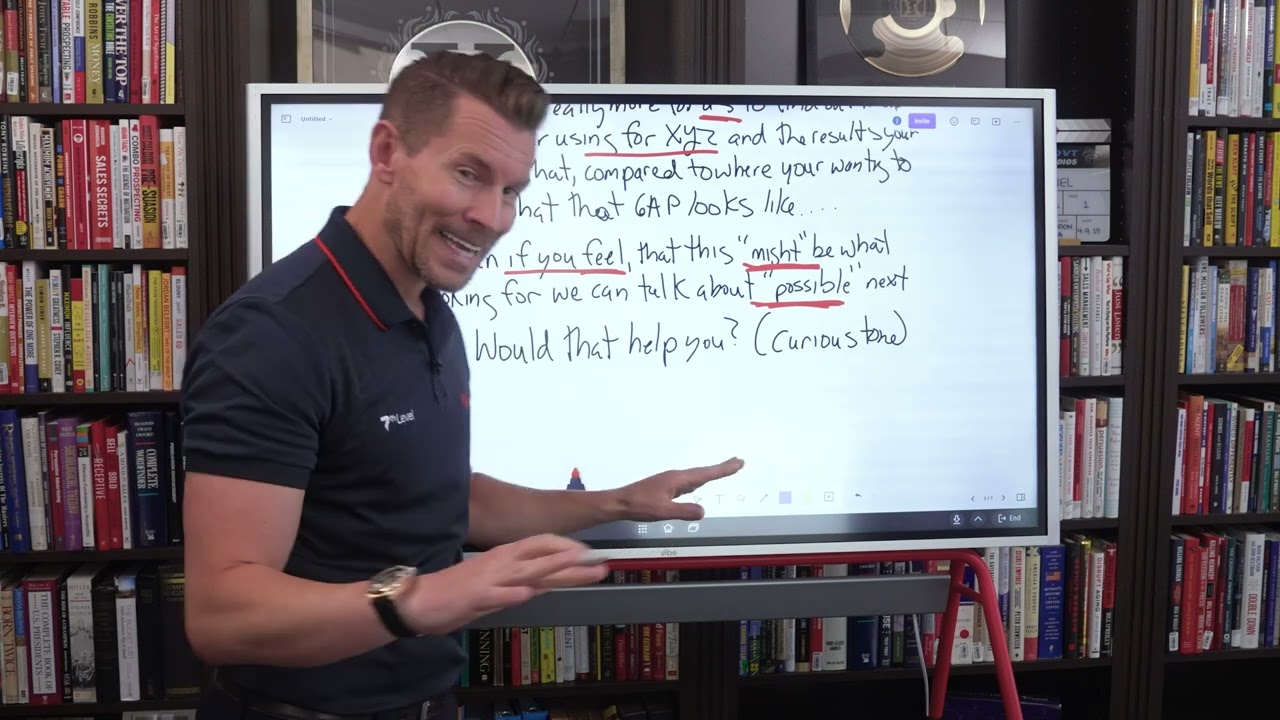
[56:37] get rid of the headaches to kind of see
[56:38] what that gap looks like.
[56:41] And then towards the end of today, if
[56:42] you feel like, "Hey, this might be what
[56:44] you're looking for, we can talk about,
[56:46] you know, uh possible next steps." Would
[56:48] that help you? No, it would not help me
[56:50] to talk about possible next steps.
[56:53] They're all going to say, "Yeah." Why
[56:55] would I use the word might be what
[56:57] you're looking for?
[56:59] We can talk about possible next steps.
[57:01] Why not be like, "And towards the end
[57:02] here, if you feel like this is a good
[57:04] fit for you and we feel like you're a
[57:05] good fit for the program, we'll show you
[57:07] how to get started. Fair enough?"
[57:09] Fair enough.
[57:11] Surface level.
[57:14] Why not assume? Do you know why? A types
[57:16] are going to do what? Well, I'm just
[57:18] still looking around. I didn't say that
[57:19] I'm ready to do anything yet. And what
[57:21] did you just trigger?
[57:24] Sales resistance. Now, the guard's up.
[57:27] Oh.
[57:28] Just shot yourself in the foot.
[57:30] But if I just put in the words might be
[57:32] what you're looking for. See, this is
[57:33] the beginning. Towards the end, I can be
[57:35] more assumptive. I don't have trust or
[57:37] credibility in the first 3 minutes,
[57:38] right? If they don't know me. Might be
[57:40] what you're looking for, we can talk
[57:41] about possible next steps. I neutralize
[57:45] and I never get any resistance. The
[57:46] guard stays down. Would it be easier,
[57:48] just possibly easier to sell
[57:51] if the prospects just had their guard
[57:53] down
[57:54] every single time you talked to them?
[57:57] Probably, right? All right, let's keep
[57:58] going here. We're just starting here.
[57:59] Now, situation questions. How do we help
[58:01] them find out what their real situation
[58:03] is? Because if we can't help them find
[58:05] out their real situation, how do we
[58:07] build a gap to where they want to be if
[58:09] they don't know where the heck they're
[58:10] at now?
[58:12] That could be trouble, right? How do we
[58:13] do that?
[58:15] All right, let me give you some examples
[58:16] here.
[58:18] Now, this
[58:19] my situation questions are all going to
[58:21] be different based off what?
[58:23] Why they're there, right? We're not
[58:25] going to ask cookie cutter situation
[58:27] questions. If they're there for chronic
[58:28] headaches, we're not going to be asking
[58:29] about numbness in their hands or feet.
[58:32] Well, maybe we are, we'll see, okay?
[58:34] Now, okay, so I see here on the form
[58:35] that you had mentioned that you might be
[58:38] having some issues with like numbness in
[58:41] your feet. Can you tell me a little bit
[58:43] more about that?
[58:45] What are those little periods? What are
[58:47] those dots do? See those little dots in
[58:50] between this and you're like, "Jeremy,
[58:51] that is not proper grammar."
[58:53] I never listen to anybody that does not
[58:55] do proper grammar.
[58:57] Spelling bee Nazis. Why would I have
[59:00] little periods there?
[59:01] It's an example of what's called verbal
[59:04] pausing.
[59:05] See, a lot of you What What if I ask
[59:07] these questions this fast? I see here on
[59:09] the form you mentioned you might be
[59:10] having some issues with numbness in your
[59:11] feet. Can you tell me a little bit more
[59:12] about that? Yeah, I just have some
[59:15] numbness and stuff and
[59:17] just been noticing for a while.
[59:20] See, you say the question so fast, they
[59:21] have no time to internalize what you're
[59:24] asking.
[59:25] That's why you get surface level answers
[59:28] cuz you're not giving them time to think
[59:29] through what you just asked. But if I
[59:31] go, "Okay, so I see on the form you had
[59:33] mentioned that you might be
[59:35] having some issues with like
[59:37] pain, I guess like in your lower back.
[59:40] Um can you can you tell me a little bit
[59:42] more about that?"
[59:45] See, I'm verbal pacing the question out.
[59:47] What does that do?
[59:49] It causes the prospects to internalize
[59:52] and think deeper about what I'm asking.
[59:56] Now, that does what?
[59:58] They start to what?
[01:00:00] Go below the surface. That's where
[01:00:04] our emotions are. See what we're
[01:00:07] starting to do here. Then I can keep
[01:00:08] going. And now, besides the the lower
[01:00:10] back pain, what other what other
[01:00:12] symptoms are you are you having to deal
[01:00:14] with?
[01:00:15] What type of tone did I just use there?
[01:00:18] Concern. Why?
[01:00:20] My tone is how the prospect interprets
[01:00:22] the intention behind the question. So,
[01:00:25] besides the lower back, like what other
[01:00:29] what other symptoms are you having to
[01:00:30] deal with?
[01:00:32] Now, Mary feels what?
[01:00:35] That I'm concerned
[01:00:38] for her pain. And if she feels that I'm
[01:00:41] concerned for her pain, not just trying
[01:00:43] to
[01:00:44] Besides the lower back, what other
[01:00:45] symptoms are you dealing with?
[01:00:48] Flat tone, monotone tone, nothing.
[01:00:51] Concern tone, now she feels what?
[01:00:54] That I care for her.
[01:00:56] And she starts to build what with me?
[01:00:59] Trust.
[01:01:01] Do you see what we're doing here?
[01:01:02] There's so much more to this. Okay, but
[01:01:04] how how frequently are you how
[01:01:06] frequently are you getting the fatigue
[01:01:08] though?
[01:01:11] Oh, I'm getting it blah blah blah blah
[01:01:12] blah. So, let's say that
[01:01:14] they start telling me how long they've
[01:01:16] been doing this. Now,
[01:01:19] can I role-play with one of you here
[01:01:21] real quick? We're going to run out of
[01:01:22] time.
[01:01:29] I'm running out of time. Okay, here we
[01:01:31] go. It's touchy when you're
[01:01:33] Can we role-play? You're really good at
[01:01:34] role-play. Do you have a Do we have a
[01:01:36] mic here?
[01:01:37] Right here in the front.
[01:01:39] Okay, are you a chiropractor case
[01:01:40] manager? No. What are you?
[01:01:42] I am a laser technician at the North
[01:01:44] Olympic clinic. Hm, would you know like
[01:01:45] all these answers?
[01:01:47] Um sure. Who would? Okay, you. I'm Kyle.
[01:01:51] Thank Thank you. Thank you. Thank Case
[01:01:52] manager. Perfect. Kyle. Okay, Kyle, can
[01:01:55] you be a patient real quick? Now, I'm
[01:01:56] not like a chiropractor, so I'm not like
[01:01:59] really educated in all this, even though
[01:02:00] we train Okay, could be could be a could
[01:02:03] be trouble. Okay, so just just roll with
[01:02:05] me, okay? Okay, so I see in the form
[01:02:07] here you you mentioned you might be
[01:02:12] numbness in your feet. Can you Can you
[01:02:14] tell me a little bit more about that?
[01:02:16] Yeah, you know, just over the last
[01:02:17] couple years actually when it started, I
[01:02:19] just kind of was like, "Hm, this kind of
[01:02:21] feels funny." How do you mean feels
[01:02:24] funny? Well, it was just different. Kind
[01:02:26] of like I'm walking on a watered up sock
[01:02:28] all the time.
[01:02:29] Different?
[01:02:30] Yeah, you know, just like I'm walking on
[01:02:32] somebody else's feet. Like they're not
[01:02:33] my feet. Uh
[01:02:35] what How How do you mean by that? Just
[01:02:37] so I understand.
[01:02:38] Well, so Okay. Just like right now,
[01:02:41] I'm standing and it feels like there's a
[01:02:43] old sock, but if I took my shoe off,
[01:02:45] there's nothing wrong. Hm, okay. And
[01:02:47] then how besides the blah blah blah blah
[01:02:50] blah, what other symptoms are you
[01:02:53] dealing with with that? Well,
[01:02:56] I can't shower with my eyes closed. You
[01:02:58] can't what? I can't shower with my eyes
[01:02:59] closed. Hm, and what else?
[01:03:02] Well, my golf game sucks, but How often
[01:03:05] do you typically golf though like before
[01:03:07] the issue? What's that? How How often
[01:03:09] were you golfing before the the
[01:03:11] numbness?
[01:03:13] Three, four times a week. Oh, you were.
[01:03:15] Yeah. Okay, and how how long have you
[01:03:17] stopped having to golf though? How long
[01:03:19] ago?
[01:03:20] Hm, kind of started lying to my buddies
[01:03:23] about a year ago. A year ago? That long?
[01:03:25] Okay, so you've been having to to deal
[01:03:27] with the the numbness in the feet for
[01:03:29] the past year, but I mean besides the
[01:03:31] the golf, cuz that's just fun. You know,
[01:03:35] has it had a has it had a
[01:03:38] impact on you?
[01:03:40] Yeah. In what way? Yeah. Uh my German
[01:03:43] Shepherd suffers cuz I can't walk her as
[01:03:45] much. Really? Yeah. What else?
[01:03:48] Well, When you say she suffers, what do
[01:03:50] you mean? Well, she's not getting
[01:03:52] exercise. Hm. Well, So, nobody's walking
[01:03:55] her?
[01:03:55] Nope. Okay, let's just stop. Okay, so
[01:03:59] good.
[01:04:00] What am I doing there? You're like, "Why
[01:04:02] is he talking about the dog? Why is he
[01:04:03] talking about the golf?
[01:04:05] Why doesn't he focus on the physical
[01:04:06] pain?"
[01:04:08] What am I doing?
[01:04:12] I'm starting to find out what the pain
[01:04:15] is preventing him from being able to do.
[01:04:18] Okay? Now, that's just the start of it.
[01:04:20] Okay? Let's keep going here. I'm going
[01:04:21] to show you some other things here cuz
[01:04:23] it gets more
[01:04:24] Now, we're going to skip these probing
[01:04:26] questions. We're running out of time.
[01:04:29] Now, problem awareness questions. So,
[01:04:31] now that we've There's other situation
[01:04:33] questions you have to ask, but now that
[01:04:35] we understand what the real situation is
[01:04:36] and more importantly, they understand
[01:04:38] the real situation,
[01:04:41] how do we build a gap
[01:04:43] and help them find problems they didn't
[01:04:45] know they had? Because if you can only
[01:04:46] help them find one problem,
[01:04:49] are they likely to buy? Whereas if I'm
[01:04:52] able to help them find two or three or
[01:04:54] four or five other problems they didn't
[01:04:56] realize they had, who is more likely
[01:04:58] going to get that sale? Well, I will
[01:05:00] every time because even if they figure
[01:05:02] out like, "Well,
[01:05:03] I mean this one problem's not that bad."
[01:05:06] But then you've got boom boom two,
[01:05:07] three, four, five other problems in
[01:05:08] their mind. They're like, "I have no
[01:05:10] choice. I have to I have to change."
[01:05:11] Okay? So, how do we build the gap?
[01:05:14] I'm going to give you a few examples
[01:05:16] here. Look at this.
[01:05:18] So, I after I get in this and it's all
[01:05:19] my problem awareness questions are not
[01:05:21] going to be cookie cutter, right? It's
[01:05:22] going to be based off what they told me
[01:05:24] in my situation questions. So, I mean
[01:05:27] you've been on XYZ medication for the
[01:05:29] last 12 months. I mean,
[01:05:31] what's caused you to feel like
[01:05:33] it's not going to get rid of the
[01:05:36] Repeat back the problem.
[01:05:38] Why would I do something like that if
[01:05:40] they're on a medication? Why would I
[01:05:41] ever say that? You've been on XYZ
[01:05:43] medication the last 12 months. I mean,
[01:05:47] that's not going to get rid of the
[01:05:48] numbness in the feet?
[01:05:50] Well, the reason why it's not going to
[01:05:51] get rid of the numbness is because of
[01:05:53] this, because of this, because of this.
[01:05:54] And what did I just eliminate from them?
[01:05:57] What did I just eliminate in their mind?
[01:05:59] That if they go back to that, they're
[01:06:01] never going to what?
[01:06:04] Be healed.
[01:06:05] Because sometimes you lose people
[01:06:07] and they say what? Well, I just, you
[01:06:09] know, I'll keep hoping that it the
[01:06:11] medication's going to work.
[01:06:13] See how I prevented
[01:06:15] that objection from coming up later by
[01:06:17] how I worded the question? What about
[01:06:18] this?
[01:06:19] So,
[01:06:20] how do I pronounce that word? The G
[01:06:21] word? Doctor go gab gab what?
[01:06:25] Yes, we have lots of clients in your
[01:06:27] space and I interviewed a few of them.
[01:06:28] They're like, "Yeah, I put the gab a gab
[01:06:29] what?"
[01:06:31] Oh, he knows. Nick, how the hell do you
[01:06:33] know?
[01:06:34] Gabapentin.
[01:06:37] See, you know.
[01:06:41] I was the number How was I the number
[01:06:42] one salesperson in all four industries
[01:06:45] that I sold in in my 17-year career.
[01:06:48] And I can tell you, I never even knew
[01:06:50] how most of the products or services
[01:06:52] worked.
[01:06:59] Cuz I wasn't selling that. I was selling
[01:07:01] the results
[01:07:02] of what the products and services did
[01:07:04] for them.
[01:07:05] And that's what I knew.
[01:07:08] I don't need to know all the technical
[01:07:09] features. Okay, let's keep going.
[01:07:11] So, you've been on
[01:07:13] So, you've been on gabapentin with your
[01:07:14] doctor
[01:07:16] the last 2 years. I mean, what's caused
[01:07:18] you to feel like
[01:07:22] What do my tone sound like?
[01:07:25] Concerned. Well, the reason why it's not
[01:07:28] going to get rid of is here's another
[01:07:29] one. So, let's say you're
[01:07:31] They walked in and they've been seeing
[01:07:33] another chiropractor. What objection
[01:07:35] would I want to prevent? Them going to
[01:07:38] back to the other chiropractor. Some of
[01:07:41] you lose people to
[01:07:44] other chiropractors, don't you?
[01:07:46] You want me to show you how to stop
[01:07:47] doing that? Obviously, it hasn't been
[01:07:48] working if they still have the problem.
[01:07:50] So, I mean you've been using ABC
[01:07:52] chiropractor the last 4 years. I mean,
[01:07:55] they're
[01:07:56] they're fairly decent. I mean, what's
[01:07:58] caused you to feel like
[01:08:00] you might want to look at someone else?
[01:08:03] What did I just do there?
[01:08:06] Why would I say, "I mean they're fairly
[01:08:07] decent"?
[01:08:08] Why wouldn't I say, "They're great"?
[01:08:12] Why wouldn't I say, "They suck"?
[01:08:15] "They're horrible."
[01:08:16] Cuz a lot of times they'll get
[01:08:18] defensive. Well, I mean they're not that
[01:08:20] they're not bad. But if I say, "I mean
[01:08:22] they're fairly decent,"
[01:08:24] what did my tone just seed?
[01:08:27] Doubt.
[01:08:29] See how I basically just told them that
[01:08:31] the other chiropractor sucks
[01:08:34] by my tonality and they never get
[01:08:39] Do you see what I'm doing? It's all in
[01:08:40] my tone. "And they're fairly decent. I
[01:08:43] mean, what's caused you to feel like
[01:08:45] you might want to look at someone else?"
[01:08:46] Well, I mean I like Dr. Gaber, but I'm
[01:08:48] just having problems with this and he
[01:08:50] doesn't seem like he's blah blah blah
[01:08:51] blah blah. And now I just prevented
[01:08:54] Them from ever going back. They're going
[01:08:56] to be here.
[01:08:57] This is easy stuff once you learn the
[01:08:58] right skills. Okay, here's another one I
[01:09:01] might ask. Now, I'm not going to ask
[01:09:02] this question if I asked the other first
[01:09:04] one. I'm going to ask him probe and
[01:09:06] clarify. So, I mean are you Let's say
[01:09:09] they had been to another chiropractor.
[01:09:11] So, are you
[01:09:12] 100%
[01:09:15] satisfied with the results you've been
[01:09:16] getting?
[01:09:23] getting? What tone did I just use?
[01:09:27] Kind of concerned {slash} kind of
[01:09:29] skeptical. Why would I do that?
[01:09:34] Why would I use that tone? What does
[01:09:36] that seed in their mind?
[01:09:40] Why would I use 100%? Why not say, "Are
[01:09:42] you satisfied
[01:09:44] with the results you've been getting?"
[01:09:46] Why would I use 100%?
[01:09:49] Do you know why? Because no one likes
[01:09:51] anything 100%.
[01:09:54] Think about the dream car What's your
[01:09:55] dream car?
[01:09:57] That you bought. Your best car you've
[01:09:59] bought. You're like, "I love this car."
[01:10:02] Can you speak up?
[01:10:03] A Chevy Camaro. I don't Yeah, you loved
[01:10:05] that car the first day.
[01:10:09] Year down the road, you found stuff you
[01:10:12] didn't like.
[01:10:13] Think about the person you're dating or
[01:10:15] married to or whatever. The first couple
[01:10:16] months were bliss. They are perfect
[01:10:18] angels of God. And within 6 months,
[01:10:21] you're like,
[01:10:22] "God, there's some things I don't like."
[01:10:25] See, if I don't put 100% in there, that
[01:10:28] backfires.
[01:10:30] No one ever say, "Yes, I'm 100%
[01:10:32] satisfied with the results. That's why I
[01:10:34] walked in here."
[01:10:37] They're like
[01:10:38] Here's what they do.
[01:10:39] Here's what they do. They'll do this.
[01:10:41] "Well, I mean, I wouldn't say 100%." Not
[01:10:43] 100%? What don't you like?
[01:10:46] Not 100%? They'll always say, "Well, I
[01:10:48] mean, I wouldn't say 100%." Not 100%?
[01:10:52] See what I'm doing? I'm shifting their
[01:10:54] thought process. Okay, let's keep going
[01:10:56] here. All right, solution awareness
[01:10:57] questions. How do we get them to see
[01:10:58] what the future looks like once the new
[01:11:00] found problems are solved? Okay? There's
[01:11:02] a lot of other questions. My concern is
[01:11:05] you're going to take six questions I
[01:11:07] gave you and come back and like,
[01:11:08] "Jeremy, I didn't triple my revenue this
[01:11:10] year."
[01:11:11] Well, yeah, I just gave you a few
[01:11:12] nibbles here. I don't have time. They're
[01:11:14] kicking me off the stage and Well, it
[01:11:15] says 11 minutes, but I bet they'll let
[01:11:16] me go 15. Okay, so here we go. How would
[01:11:19] it How would it be different though?
[01:11:20] Like, you you being able to get rid of
[01:11:22] the the chronic headaches and how would
[01:11:25] your life be
[01:11:27] I don't know, like maybe
[01:11:29] maybe
[01:11:30] different than it is now though.
[01:11:35] Why would I
[01:11:36] slow that question down? How does it
[01:11:38] sound when I do this?
[01:11:39] How would it be different though? You
[01:11:40] being able to get rid of the headaches,
[01:11:42] how would your life be maybe different
[01:11:44] than it is now, John? Oh, I don't know.
[01:11:46] I'll probably be good.
[01:11:48] Too fast. Surface level answer. How
[01:11:51] would it be different though? I mean,
[01:11:52] you you being able to get rid of like
[01:11:56] the the headaches. Like, how would your
[01:11:58] life be I don't know, like how would
[01:12:00] your life be maybe
[01:12:03] maybe different than it is now.
[01:12:06] What did I just cause them to do?
[01:12:09] Think deeper about the question. I'm
[01:12:11] getting them to internalize. That's
[01:12:13] where the emotional side is.
[01:12:17] You learn how to do this.
[01:12:19] Physical pain has only gotten you here.
[01:12:22] Emotional pain gets you here. I can
[01:12:24] assure you this. Let's keep going here.
[01:12:31] then when they say they're like, "Oh,
[01:12:32] it'd be good. I'd be able to golf. I'd
[01:12:34] be able to walk my German Shepherd. I'd
[01:12:36] be able to do this."
[01:12:38] Can I ask a favor? I'm out of water. Can
[01:12:40] I get half hot water here and like half
[01:12:43] lukewarm water?
[01:12:50] Okay. Now, then I'm going to say, "Okay,
[01:12:52] but" They're going to say, "Oh, I'd do
[01:12:53] this. I'd do that." Okay, but what would
[01:12:55] it do for you
[01:12:56] personally though?
[01:12:59] Logical based question. First, they're
[01:13:00] going to tell me logical answers. I'd
[01:13:01] walk the dog.
[01:13:03] That's my girlfriend. Give her an
[01:13:04] applause. Thank you. I'd
[01:13:07] I'd walk the dog. So, when I ask a
[01:13:09] logical based question, they're going to
[01:13:10] give me logical answers. I'd golf more.
[01:13:13] I'd walk my dog.
[01:13:15] I'd do this.
[01:13:16] But that's still what?
[01:13:18] Logical things on how their life would
[01:13:20] be different. But then I'm going to lean
[01:13:22] in and I'm going to be like,
[01:13:24] "Okay, but being able to to do those
[01:13:26] things,
[01:13:28] what would it do for you
[01:13:30] personally?"
[01:13:32] "Oh my gosh, it would relieve so much
[01:13:34] stress." Stress? "Oh, you have no idea
[01:13:36] the stress this is causing me."
[01:13:42] Done.
[01:13:43] I don't need to do anything else.
[01:13:46] Cuz they've told themselves what?
[01:13:49] What the future looks like once they can
[01:13:51] do everything they've ever wanted and
[01:13:53] all the stress and pain are gone.
[01:13:56] But if I can't get them to open up
[01:13:57] emotionally, I get what at the end?
[01:14:00] "Sounds really good. I just need some
[01:14:02] time to think about it."
[01:14:05] Your your hand's about to fall off,
[01:14:07] dude. You want to think it over?
[01:14:09] See, okay, let's keep going here.
[01:14:11] Now, let's keep going. How would you
[01:14:13] respond to this? Anybody ever get this?
[01:14:15] Anybody ever get an email or a call and
[01:14:17] they're like,
[01:14:18] "We really liked you and what you had to
[01:14:21] say, but
[01:14:22] we just decided to Now's not a good
[01:14:24] time. We we we need to wait for the
[01:14:27] treatment. Uh we'll get back to you when
[01:14:29] we're ready. Keep in touch."
[01:14:31] Raise your hand if you've ever heard
[01:14:32] something like that. You're like, "What?
[01:14:34] You chronic headaches, you can't even go
[01:14:36] to work. What are you talking about?"
[01:14:37] How would you respond? Do you throw out
[01:14:38] a rebuttal? Tell them why they're wrong?
[01:14:41] How often does that work?
[01:14:43] Uh one out of 50.
[01:14:45] So, you keep doing it, right? It's like
[01:14:46] golf.
[01:14:47] You get one
[01:14:49] good swing out of 100, so you keep going
[01:14:51] to golf cuz you think it works, right?
[01:14:53] But that's the numbers game approach.
[01:14:54] What if we played the skills game? What
[01:14:56] if I could get it to work nine out of 10
[01:14:57] times and I said this by using an NPQ
[01:15:00] consequence question. I call them back
[01:15:01] and I'm like, "Hey, Mary, I got your got
[01:15:03] your email. That's not a problem. Um you
[01:15:06] know, you can always come back later.
[01:15:07] Can I um
[01:15:09] Can I Can I ask you something though?"
[01:15:12] "Sure, yeah. What's going on?"
[01:15:14] Um
[01:15:15] "How can I
[01:15:17] communicate to you that you
[01:15:20] that you might be making a mistake
[01:15:23] without you getting upset with me?" "Uh
[01:15:25] sure, yeah. What What do you have in
[01:15:27] mind?"
[01:15:32] No one will ever say, "No,
[01:15:34] I'm upset with you that I
[01:15:36] that you said I might be making a
[01:15:38] mistake."
[01:15:44] Can I ask you something?
[01:15:46] "Sure, go ahead." "How can I communicate
[01:15:48] to you that you
[01:15:53] without you getting upset with me?"
[01:15:56] "Uh sure, yeah. What What do you mean?"
[01:15:57] Then I'm going to loop back around and
[01:15:59] I'm going to ask a consequence question
[01:16:00] because yeah, I mean,
[01:16:02] Mary, from what you told me, I mean,
[01:16:03] what happens if you don't do anything
[01:16:05] about this now?
[01:16:06] Your nerves get pinched off
[01:16:09] and they have to amputate.
[01:16:13] "Well, I I never really thought about
[01:16:14] that. I mean,
[01:16:15] do you I mean, do you want to have to go
[01:16:17] through all that and all the
[01:16:19] complications that come after that if
[01:16:22] if you didn't have to?" "Well, no, I
[01:16:25] didn't have to, but I just don't know if
[01:16:26] it's just expensive."
[01:16:28] Well, in reality,
[01:16:31] which is more expensive?
[01:16:33] I mean, is it more expensive for you to
[01:16:35] get the funds together and we take you
[01:16:38] through the treatment and your
[01:16:40] you know, your feet get saved
[01:16:43] and you're able to walk around and spend
[01:16:45] time with your grandkids the next 30
[01:16:46] years
[01:16:48] or is it more expensive
[01:16:51] if you don't do anything right now
[01:16:54] and your nerves get pinched
[01:16:57] and they amputate
[01:17:01] and you're in a wheelchair the rest of
[01:17:02] your life?
[01:17:04] I mean, reality,
[01:17:10] What tone did I just use?
[01:17:13] And how does she interpret why I asked
[01:17:14] that question?
[01:17:16] Does she interpret that I'm just trying
[01:17:18] to make a sale and make money
[01:17:20] or does she interpret that I'm genuinely
[01:17:22] concerned about the major implications
[01:17:24] and consequences of what happens if she
[01:17:26] doesn't do anything?
[01:17:29] And if she feels that I am concerned and
[01:17:31] genuine
[01:17:32] and I've built that gap, that trust in
[01:17:34] the pain of the emotions,
[01:17:37] what do you think's going to happen nine
[01:17:38] times out of 10?
[01:17:41] She's going to get in the treatment
[01:17:42] plan.
[01:17:43] And you
[01:17:45] then become a problem solver
[01:17:47] and you change this woman's life
[01:17:49] forever.
[01:17:51] However, on the flip side,
[01:17:53] if you don't learn this
[01:17:56] and she says no,
[01:18:02] her life goes in a different direction.
[01:18:05] And who's responsible for that? We are.
[01:18:09] This is why communication
[01:18:12] is the most important thing you can
[01:18:13] learn if you really want to solve your
[01:18:17] people's problems. Cuz if I can't
[01:18:19] communicate to them,
[01:18:20] they don't buy and I can't help them.
[01:18:25] Is that why you got into what you're
[01:18:28] doing now?
[01:18:30] Okay. Now, we've got a few minutes left.
[01:18:32] Now, anybody want more questions like
[01:18:34] that? I don't have a lot of more time.
[01:18:35] They are going to yell at me. I've only
[01:18:36] got 4 minutes, which really means nine
[01:18:39] in my mind.
[01:18:40] I love it. I know. I get thrown off
[01:18:42] every stage.
[01:18:44] Um I'm going to give you a QR code. I'm
[01:18:46] going to give you what's called the NPQ
[01:18:47] black book of questions.
[01:18:49] This is our updated version. We're
[01:18:50] releasing it in 3 days. It's 161 pages.
[01:18:54] The old one was 58. Give a lot of
[01:18:56] different industry specific examples. I
[01:18:57] think some of them for you guys as well.
[01:18:59] I'm going to give you the the QR code.
[01:19:01] I'm going to give you 10 seconds. 10
[01:19:04] 9
[01:19:05] 8
[01:19:07] 7
[01:19:08] 6 5 4 3 2 1. Now, you have to take a
[01:19:12] picture of me because when you This is
[01:19:14] the only way I can get this to you. When
[01:19:15] you join this group, this is one of our
[01:19:16] free Facebook groups, Sales Revolution.
[01:19:18] There's like 110,000 some people there.
[01:19:21] Maybe more now, I'm not sure.
[01:19:23] When you get in there, you need to
[01:19:24] message a picture of me. Take a picture
[01:19:25] of me now.
[01:19:32] This is your code word. If you don't
[01:19:33] have this picture, you will not get the
[01:19:35] book. I'm going to give it to you for
[01:19:36] free. I told Dr. Gumm and his team I
[01:19:38] would. This is your you got to take a
[01:19:40] picture of me. You don't get If you
[01:19:41] don't have the picture, that is your
[01:19:42] passcode. You're like, I saw Jeremy,
[01:19:44] this weird guy with the two parts on his
[01:19:47] hair. I don't know why he does that, on
[01:19:49] stage, and I want the black book. You
[01:19:51] message me in there. Somebody in my team
[01:19:53] will message you back. It won't be me. I
[01:19:54] have like 20,000 messages a day.
[01:19:56] Somebody in my team will message that.
[01:19:57] We'll give it to you for free. Did that
[01:19:58] help you? Start. Okay. I've got a few
[01:20:00] more things. Step three. Oh my god,
[01:20:02] Jeremy. Step three, I've got 5 minutes.
[01:20:05] How do we eliminate sales resistance
[01:20:06] where the prospects let their guard
[01:20:07] down?
[01:20:09] This is the most important thing you can
[01:20:10] ever learn in your life.
[01:20:12] It's about neutralizing the hidden
[01:20:14] pressure that you're having in your
[01:20:15] conversations that you don't even know
[01:20:18] with pretty much every prospect you're
[01:20:20] talking to.
[01:20:21] Anybody ever heard of this? Anybody ever
[01:20:23] watch this movie?
[01:20:25] Put that coffee down. Coffee's for
[01:20:26] closers, right?
[01:20:29] ABCs of closing, that's what average
[01:20:30] sales people do.
[01:20:32] You don't want to be average.
[01:20:36] Selling is not adversarial. It's not you
[01:20:39] against the prospect trying to win them
[01:20:40] over so you make money.
[01:20:42] That will only get you this far.
[01:20:45] You want to be at the top? Selling's
[01:20:47] collaborative. You working with the
[01:20:49] prospects to help them find and solve
[01:20:50] problems they didn't realize they had.
[01:20:53] we're going to teach you, start here in
[01:20:55] the next 4 minutes, the ABDs of selling.
[01:20:58] That stands for always be disarming. No
[01:21:01] more always be closing. Now, do I mean
[01:21:04] that when that patient's there, I get to
[01:21:05] the end and be like, well,
[01:21:07] uh I guess email me back if you're
[01:21:10] interested. That ain't going to help
[01:21:12] you.
[01:21:13] Okay? We have to learn how to get them
[01:21:15] to commit to take the next step to solve
[01:21:17] their problems by purchasing what you're
[01:21:18] offering, but we have to disarm them.
[01:21:20] Now, how do we do that? You ever get
[01:21:22] this objection? Can you just tell me how
[01:21:23] much it's going to cost and I'll tell
[01:21:24] you if I'm interested.
[01:21:26] Anybody ever get that? Raise your hand.
[01:21:29] Ooh.
[01:21:31] What do you feel like you said
[01:21:34] or didn't ask
[01:21:36] or how you used your tone that triggered
[01:21:38] them to say that to you?
[01:21:42] Bet you never thought about that. Mhm.
[01:21:45] Now, we have three choices when we get
[01:21:47] this objection.
[01:21:49] We can do this.
[01:21:53] Tell them the rate without building a
[01:21:54] gap. It's going to be this.
[01:21:57] When you do that,
[01:21:58] in the first 3 minutes, how many of them
[01:21:59] like, "Wow, that's great. 15,000, I'm
[01:22:03] in."
[01:22:05] What do they say?
[01:22:07] That's just a lot of money. I I don't
[01:22:08] I'm not sure.
[01:22:10] Boom, gone. Done. That probably is not a
[01:22:12] good strategy. Second strategy, sweep it
[01:22:14] under the rug, hope and pray they don't
[01:22:16] bring it up. I'm going to ignore it. Oh,
[01:22:18] yeah, we'll go through that later. Now,
[01:22:19] let me ask you.
[01:22:21] And then what do they do 2 or 3 minutes
[01:22:22] after that?
[01:22:24] Hey, just tell me. And they get
[01:22:25] irritated cuz you just lost what? Trust.
[01:22:29] Cuz they know you're hiding it. Don't do
[01:22:32] that. It's not good. Or we can do this.
[01:22:34] Answered indirectly where it makes sense
[01:22:36] while we're ask I didn't mean to make
[01:22:37] that bad face at you. I think I think I
[01:22:39] made a bad face. It was not meant to
[01:22:40] you. That was meant to me. I don't want
[01:22:42] to offend you. Okay, I I saw that. I'm
[01:22:44] like, that was a really bad face I made
[01:22:45] there. What was going on?
[01:22:49] All right. So, here's what we're going
[01:22:50] to do.
[01:22:51] We're just going to agree with them.
[01:22:53] Oh, yeah, for sure. I mean, we'll go
[01:22:55] through all that for sure. I mean, it's
[01:22:57] really all going to depend on like the
[01:22:58] results of your thermal picture. You
[01:23:01] know, that's going to show us the the
[01:23:02] kind of blood flow you're getting into
[01:23:04] your foot. Uh you know, the results of
[01:23:06] your neuropathy test and and really, you
[01:23:09] know, what your X-rays look like as far
[01:23:11] as like, you know, structural changes
[01:23:13] like any disc damage. And and once I can
[01:23:16] see all that and understand all those
[01:23:18] details, I can go through all the
[01:23:20] different options we have for our
[01:23:21] clients. Would that help you if I did
[01:23:22] that for you?
[01:23:24] No, it would not help me.
[01:23:27] Yeah, sure. And now, it makes sense why
[01:23:30] I'm what?
[01:23:32] Asking the questions. Does it depend on
[01:23:34] all those things if that's their issue?
[01:23:37] How can you tell them the price when you
[01:23:39] don't even know what?
[01:23:41] See what I'm doing there, okay? See how
[01:23:43] easy I just got them to do what? Let
[01:23:47] their
[01:23:48] guard down.
[01:23:50] If I can't let their guard down, they
[01:23:52] stay surface level, I get tons of
[01:23:55] objections. Most of the time, I lose the
[01:23:58] sale. If I can let their guard down,
[01:24:01] I don't lose the sale. Okay, how about
[01:24:03] another one? Anybody ever get this
[01:24:04] objection? Sounds really good. This is
[01:24:06] the last one.
[01:24:08] Actually, I'm out of time.
[01:24:10] Should I get off the stage before I show
[01:24:11] you how to overcome this one?
[01:24:13] Oh, cliffhanger.
[01:24:15] Oh, right. It's like the you know, the
[01:24:17] episodes of like you guys were watched
[01:24:19] 24 when it first came out like the you
[01:24:21] know, the Lost and everything. You'd get
[01:24:23] to the end and you're like, I got to go
[01:24:24] to bed. It's 3:48 Monday night. Okay,
[01:24:27] I'm going to watch one more.
[01:24:31] I always save this one for last. I mean,
[01:24:33] how can you ever Nobody wants to kick me
[01:24:34] off here. Oh, it sounds really good, but
[01:24:36] I just need to think it over. Now, is I
[01:24:38] want to think it over an an objection?
[01:24:41] Is it?
[01:24:43] Do they leave your office and go home
[01:24:46] and they're like,
[01:24:47] I really need to think this through.
[01:24:48] Let's see. Um Let me get the Excel
[01:24:51] spreadsheet out
[01:24:52] and I'm going to type in like if I if I
[01:24:55] had these chronic headaches for 1 month,
[01:24:56] 3 months, my disability payments like I
[01:24:58] need to really think this over.
[01:25:01] When you tell a salesperson you want to
[01:25:02] think it over, do you go back home and
[01:25:04] think through it really seriously for
[01:25:06] the next 3 to 6 weeks? No. You just had
[01:25:09] a concern and you didn't want to tell
[01:25:11] them, so you just you wanted to make
[01:25:13] them feel good, right?
[01:25:15] That's what they're doing to you.
[01:25:17] So, I have What's my job to do here? I
[01:25:20] have to find out what the real concern
[01:25:23] is.
[01:25:24] How do I do that? By getting them to
[01:25:27] let their guard down and tell me. Ooh,
[01:25:30] you guys are good. You're good. This is
[01:25:31] fun. So, I'm going to do this. Oh, yeah.
[01:25:34] Yeah, not a problem. Uh what's your time
[01:25:36] frame on getting back to me in the next
[01:25:38] day or two just to see if I'll be
[01:25:39] available for you.
[01:25:42] Jeremy, what are you doing? You're
[01:25:43] you're not trying to overcome the
[01:25:45] concern?
[01:25:46] Um I am.
[01:25:48] But how can I let How can I get them to
[01:25:50] let their guard down?
[01:25:52] If they think it's over and we're
[01:25:54] setting up another appointment,
[01:25:56] what starts to happen to the guard?
[01:25:59] Starts to come down cuz we're about to
[01:26:01] leave. He or she's about to leave the
[01:26:02] office, right? Oh, yeah, not a problem.
[01:26:04] What's your What's your time frame on
[01:26:05] getting back to me in the next day or
[01:26:07] two to see if I'd be available for you.
[01:26:10] Why would I say just to see if I'd be
[01:26:11] available for you? What does that do?
[01:26:13] Does that raise my status that maybe I'm
[01:26:15] busy? I've got lots of clients.
[01:26:18] See, I'm raising my status by how I'm
[01:26:20] positioning it.
[01:26:21] Now, a lot of people are like, well, I
[01:26:22] could call you back next week. I could
[01:26:26] Waffle. Don't let them do that cuz they
[01:26:28] don't what? They don't call you back in
[01:26:30] a week, do they? Surprise, surprise.
[01:26:32] Well, possibly.
[01:26:34] Not sure if I'd randomly be available
[01:26:36] like that with my client schedule.
[01:26:38] Um what I can do if you have your
[01:26:39] calendar handy, I can pull up mine and
[01:26:42] have you book a specific time with me.
[01:26:44] That way you don't have to chase me down
[01:26:45] and vice versa. Would that help you?
[01:26:50] What did I just do with my status?
[01:26:53] That way you don't have to chase me
[01:26:54] down.
[01:26:55] See, who has the problems?
[01:26:57] I don't have the problems.
[01:26:59] The prospect has the problems.
[01:27:02] Why Why are you qualifying to the
[01:27:03] prospect when they're the ones that have
[01:27:04] the problems?
[01:27:06] You're the one that can what? Solve the
[01:27:07] problems.
[01:27:09] So, you're going to start learning how
[01:27:10] to get the prospects to qualify to you
[01:27:13] cuz you're the one that solves the
[01:27:14] problems, right? They're Okay, let's say
[01:27:16] we book a time. They're coming back on
[01:27:19] We're going to talk on the phone on
[01:27:20] Tuesday.
[01:27:22] Mhm, not so fast. Cuz I need to find out
[01:27:25] what their concern is. Now, hey, um bef-
[01:27:28] before you go,
[01:27:30] what were you um
[01:27:31] what were you wanting to go over in your
[01:27:32] mind just so I know what questions
[01:27:35] you'll have when we talk on Tuesday.
[01:27:37] Well, you know, it's just a big decision
[01:27:39] and I'm just not sure we have the money
[01:27:41] for it.
[01:27:43] What did I just find out?
[01:27:46] It's a money concern.
[01:27:47] And oh, I'm right there in front of
[01:27:51] Now I know the concern, so what I can
[01:27:53] What can I do now? Help them overcome
[01:27:55] the money concern and get them into the
[01:27:57] treatment program.
[01:28:00] Instead of saying, "What do you need to
[01:28:01] think about?"
[01:28:03] They get Well, I just I have to think
[01:28:05] about big decisions. Defensive. Yeah,
[01:28:07] what was it that you were wanting to go
[01:28:08] over in your mind just so I know what
[01:28:10] questions we'll have when we talk again.
[01:28:14] Well, I just don't know if this is the
[01:28:16] right treatment plan because my doctor
[01:28:18] says that this doesn't work.
[01:28:21] See, that's the real concern because if
[01:28:23] you couldn't help them tell you what the
[01:28:24] real concern is, were they going to show
[01:28:26] up a couple days later? Were they going
[01:28:27] to answer the phone? Hell no, you don't.
[01:28:29] You see what we're doing there? See,
[01:28:30] we're learning how to humanize the
[01:28:32] conversation here. All right. Thank you
[01:28:35] for being up here. We went over the
[01:28:36] three steps to becoming the trusted
[01:28:38] authority in your prospect's mind,
[01:28:40] becoming a problem finder, not a product
[01:28:42] pusher, no bueno,
[01:28:44] asking the right questions at the right
[01:28:45] time, eliminating sales resistance. Now,
[01:28:48] here's a book I brought. Now,
[01:28:49] unfortunately, how many are in here? 8,
[01:28:51] 900?
[01:28:53] We only were able to get our publisher
[01:28:54] to ship like 150 to 200 books, but I'm
[01:28:58] going to I told Dr. Gumm I would give
[01:28:59] you guys our best-selling book, Wall
[01:29:01] Street Journal best-seller, Barnes &
[01:29:02] Noble best-seller book for free.
[01:29:05] So, we've got some books back there.
[01:29:06] Look I got some guys here. Got the
[01:29:08] orange books.
[01:29:10] Now, if you guys want a book, I'm going
[01:29:12] to give it to you for free, okay? If you
[01:29:15] If we we've out, you'll have to get the
[01:29:16] QR code here to buy it from Barnes &
[01:29:18] Noble. Let us know if you know that if
[01:29:19] you need the uh like a GoFundMe page for
[01:29:21] the $17 to learn how to sell more.
[01:29:24] We'll talk about that. And then uh we'll
[01:29:26] give you the a free book. I'll even sign
[01:29:28] it for as many as I can, as long as you
[01:29:30] take a picture
[01:29:32] of us doing it and you tag me on
[01:29:34] Instagram.
[01:29:36] Now, as we close up, one last thing
[01:29:38] before they boot me off the stage,
[01:29:46] is training something you did
[01:29:50] or is training something you do?
[01:29:53] As a chiropractor, is training something
[01:29:55] you did in the past
[01:29:58] or is it something you do?
[01:30:01] Something you do if you want to be at
[01:30:02] the top, right?
[01:30:04] Now, in sales, in communication,
[01:30:11] or is training something you do daily?
[01:30:15] It's something you do daily if you want
[01:30:17] to grow your practice very, very
[01:30:19] quickly. Thanks for allowing us to be
[01:30:21] here. I'll talk to you guys here at the
[01:30:23] end when I sign the books and
[01:30:24] everything. Love you guys. We'll even
[01:30:26] help you. We We have tons of clients
[01:30:28] that crush it in your space. You have
[01:30:30] questions about scripting and I don't
[01:30:32] know if this question works. Just ask me
[01:30:34] and our team. We will help you for that.
[01:30:36] Thank you very much. Thank you. JEREMY
[01:30:38] MINER!
[01:30:40] THANK YOU, MAN. Appreciate you.